
The Empathy Protocol
What happens when a leader who never felt anything suddenly learns the power of empathy?

I wrote this story last autumn and originally published it on Substack in two parts. I am now sharing it here as a single piece.
This is a work of fiction. The events, characters, institutions, and political circumstances described are invented. Any resemblance to real persons, living or dead, or to actual events, is entirely coincidental.
At its core, the story is not about one specific leader, party, or country. It is a satire about power, emotional emptiness, manipulation, and the dangerous possibility that even empathy, once discovered, can be turned into a weapon.
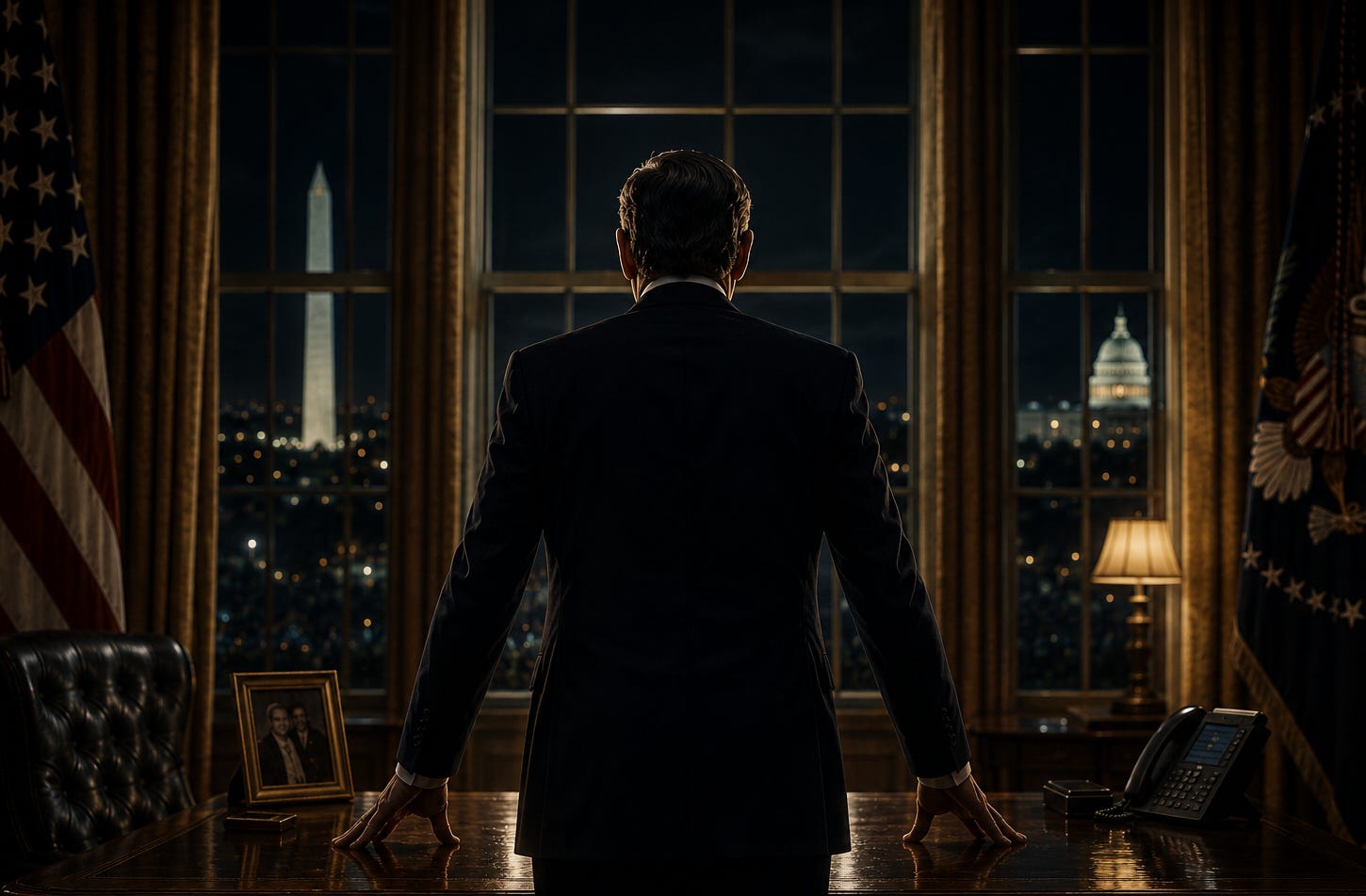
The Empathy Protocol
The meeting started badly and got worse from there.
By the time Marcus Hale said, “We’re collapsing,” most people in the room already knew it.
The conference room was cold. Half-drunk coffees sat beside polling folders and legal pads. Marcus stood near the screen at the front.
“We’re down almost everywhere that matters,” he said. “Michigan’s slipping. Arizona’s ugly. Donors are nervous, which means we are nervous, which means everyone’s pretending not to panic.”
A few people looked down.
“It’s not policy anymore,” Marcus continued. “People are exhausted.”
He stopped there. Nobody wanted to say the next part first. Finally, a woman near the end of the table cleared her throat softly.
“It’s him.”
Marcus nodded once.
“He’s getting harder to manage. He picks fights nobody understands. Briefings go off the rails. Half the communications team rewrites statements after midnight because nobody knows what he’s going to say by morning.”
Still, nobody defended him.
At the far end of the table sat Dr. Adrian Cole, hands resting loosely together, listening with an expression that suggested either patience or exhaustion.
Marcus looked toward him.
“If this keeps going,” he said, “he’s not just going to lose. He’ll burn through everyone around him on the way down.”
Cole spoke without changing posture.
“There may be a way to stabilize some of the behavior.”
A few heads lifted. Marcus gave a short laugh.
“That sounds expensive.”
Cole ignored him.
“There’s a compound under restricted development. Originally intended for severe narcissistic pathology and impulse regulation.”
Nobody said anything for a moment.
Then one of the advisors near the wall said quietly, “You can’t be serious.”
Cole turned toward him.
“I’m entirely serious.”
Marcus rubbed at one eye. He hadn’t slept properly in days.
“You’re talking about medicating the President.”
“I’m talking about reducing behavioral escalation.”
“That’s a very polished way to say the same thing.”
Cole accepted that with a small nod. Marcus looked down at the polling sheets again.
“What exactly does this thing do?”
Cole took a little too long answering.
“The idea is that it disrupts some of the emotional loops,” Cole said. “Less compulsive dominance behavior. Better recognition of consequences. More awareness of other people.”
Marcus stared at him.
“You mean empathy.”
Cole hesitated briefly.
“Something in that direction.”
“And the side effects?”
Cole glanced down at the folder.
“Emotional recall. Attachment formation. Regret, occasionally.”
Somebody near the back muttered, “Jesus Christ.”
Nobody disagreed. Marcus leaned against the edge of the table.
“Where did this come from?”
“A private research initiative.”
“That’s not an answer.”
“No,” Cole said. “It isn’t.”
Marcus watched him for another second.
“Why build something like this in the first place?”
Cole’s fingers tapped once against the folder before going still again.
“Because history suggests certain personality structures become more dangerous when insulated by power. Hitler, Stalin, Pol Pot, just think if somebody had intervened.”
Nobody moved after that. Marcus rubbed both hands slowly over his face.
“And you think this could actually work on him?”
Cole considered the question carefully.
“I think it could alter behavior.”
“That wasn’t the question.”
Cole finally looked directly at him.
“No,” he said quietly. “I don’t know what happens if someone like him starts feeling things he’s spent his entire life avoiding.”
Nobody said anything for a while.
Then footsteps sounded outside.
He’s early,” Marcus said.
The door opened hard enough to hit the stopper.
“Tell me this isn’t another meeting about messaging,” the President said as he walked in. “If I hear the phrase ‘voter empathy’ one more time, I’m firing somebody.”
Nobody laughed immediately. Then Marcus did, because someone had to. The President remained standing. He looked around the room quickly, stopping only on faces that seemed nervous.
Three marriages behind him now. No First Lady. The tabloids had eventually gotten bored trying to guess who he was sleeping with because the answers changed too fast.
“I’m told this is important,” he said. “Usually that means it’s stupid.”
Marcus cleared his throat.
“We’ve identified a strategic problem.”
The President already looked irritated.
“You people always say ‘strategic problem’ when you mean polls.”
“We’re losing support.”
“That changes every week.”
“This is different.”
The President looked at Marcus a second longer than usual. Across the table, Cole spoke for the first time since he entered.
“We think we understand part of the reason.”
The President turned toward him slowly.
“Who are you again?”
“Dr. Adrian Cole.”
“Right.” He pointed vaguely. “Medical?”
“Yes.”
The President looked back toward Marcus.
“Why is there a doctor in my campaign meeting?”
Marcus answered carefully.
“He’s here to help with… behavioral issues.”
The President stared at him.
“That doesn’t sound like a real job.”
Finally, the President sat down heavily, loosened one cuff, then pointed toward Cole.
“Fine,” he said. “Diagnose me.”
Cole didn’t open the folder.
“You’ve become disconnected from people.”
The President snorted softly.
“I’m President. Disconnected comes with the job.”
“That’s not what I mean.”
The President watched him now with more interest than irritation.
Cole continued.
“People no longer think you see them.”
A silence settled over the room.
The President leaned back slightly.
Marcus stepped in before the conversation got any worse.
“We think there may be a way to improve public connection again.”
The President looked between them.
“And how exactly do you improve connection?”
Cole answered directly.
“There’s a compound.”
The President closed his eyes briefly.
“Please don’t say supplement.”
“It’s a pharmaceutical compound.”
“So. A drug.”
“Yes.”
The President held out his hand impatiently until Marcus passed him the folder. He flipped through several pages without really reading them.
“This helps me politically?”
Marcus answered immediately.
“It improves emotional recognition. Social responsiveness. Persuasion.”
The President looked up again.
“I already know how to persuade people.”
Cole said quietly, “Not anymore.”
Marcus winced visibly. The President looked at Cole for several long seconds.
“You always talk to people like this?”
He gave a short laugh. “I’ve seen people lose jobs over less.”
“Only when accuracy matters.”
“Side effects?”
“Increased emotional sensitivity. Memory recall. Greater recognition of distress in others.”
“That sounds unpleasant.”
“It may be.”
He reached the last page and found the blister pack attached inside the folder.
For a moment, he just looked at it.
Then he pushed one capsule through the foil and swallowed it without water.
“If this makes people like me more,” he said, “I’ll probably ask for the stronger version.”
Marcus answered immediately. “That’s the idea.”
The President nodded once. “Then maybe we should’ve started years ago.”
Two hours later, the Oval Office felt crowded in a way it normally didn’t.
Cole stood near the Resolute Desk, looking over blood pressure readings while Marcus moved between phone calls and briefing folders with increasing irritation.
The President sat behind the desk, flipping through a security memo without absorbing any of it. Finally, he looked up.
“You’re all staring at me.”
Nobody answered.
“I don’t feel any different.”
Cole glanced at the laptop screen.
“It may take a little time.”
The President leaned back slightly.
“That’s disappointing. I was hoping for instant moral transformation.”
Marcus ignored that.
“We just need stability through the afternoon.”
“You sound like air traffic control.”
Marcus kept scrolling through his phone.
“At the moment, I’d settle for a safe landing.”
A knock interrupted them.
One of the younger staffers stepped halfway into the room.
“Sir, the family from the bridge collapse arrived early.”
Marcus answered immediately.
“We can reschedule.”
The President looked over.
“Why?”
Marcus hesitated just long enough to become obvious.
“We’re already running behind.”
“They’re here now,” the president said.
Marcus glanced briefly toward Cole.
“We should probably keep things controlled today.”
The President stared at him.
“Controlled?”
Marcus exhaled quietly.
“Nobody knows yet how you’re going to respond to the medication.”
The room went still for a second after that.
Then the President said, “Send them in.”
The staffer disappeared again.
A minute later, the door opened again.
The woman who entered looked exhausted. Dark coat still damp from the rain outside. Hair hurriedly pinned back. A boy followed close behind her. Thin. Quiet. Nine maybe. He kept glancing around the room quickly before looking back at the floor. Marcus stepped forward automatically.
“Mrs. Alvarez, thank you for coming. The President only has a few minutes this morning.”
The President lifted a hand slightly without looking at him. Marcus stopped talking. The woman faced the desk.
“My husband died in the bridge collapse.”
The President nodded.
“I was briefed.”
Usually, that would have been enough. Condolence. A photograph.
Instead, he asked, “What happened?”
Marcus looked over immediately.
The woman seemed surprised by the question, too.
“He was driving home from work,” she said. “The middle section collapsed before they closed traffic.” She swallowed once. “His truck went in with the others.”
The boy stayed silent.
The President noticed dried mud along the side of one sneaker.
“We didn’t get to see him afterward,” the woman continued. “They recovered the vehicle the next morning.”
Something tightened in the President’s chest.
He shifted slightly in the chair.
Cole noticed.
“My son keeps thinking his father’s still coming home,” the woman said, then gave a small, embarrassed shake of her head.
Marcus was already preparing to end the meeting. Cole could see it happening before he moved.
Then the President asked, “What was he like?”
The woman blinked.
“My husband?”
“Yes.”
For the first time since entering the room, she looked uncertain.
“He sang constantly,” she said finally. “Badly.” A tired smile flickered briefly. “Old country songs mostly. My son hated it.”
The boy rolled his eyes automatically.
The President watched that happen.
Something unpleasant moved through him unexpectedly.
A memory surfaced without warning. Standing in a kitchen years earlier, while somebody was singing in another room. One of his daughters, maybe.
The memory vanished almost immediately.
The President looked down briefly at the desk..
Suddenly, he heard himself say, “I’m sorry.”
Marcus looked up sharply.
The woman nodded politely, but her expression barely changed. She had probably heard too many official apologies already.
The President looked toward the boy again. The boy still wouldn’t meet his eyes. For a second, irritation rose automatically. Why won’t he even look at me? The thought startled him enough that he stood up abruptly and walked around the desk.
The boy finally looked at him then.
No admiration. No fear.
“I should have…” the President began.
Then stopped.
Marcus stared at him.
The President rubbed his forehead once and looked toward the windows briefly before speaking again.
“Your father should still be here.”
The boy said nothing. But his hands loosened slightly. Nobody in the room seemed entirely certain what was happening anymore.
Marcus shifted his weight. Cole stayed motionless.
The President folded his arms tightly across his chest and looked out toward the rain on the South Lawn.
“We’ll take care of things,” he said.
The woman frowned slightly.
“How?”
He opened his mouth, then paused. Marcus stepped in immediately.
“There’ll be federal support coordination. Legal assistance. Housing support if necessary—”
“No,” the President said.
Marcus stopped. The President turned back toward them.
“I’ll handle it personally.”
The woman looked uncertain whether to thank him or distrust him.
“Marcus will get your information before you leave.”
His voice sounded steadier now. Closer to normal.
As the family left, the boy glanced back once before the door closed.
The President remained standing by the windows afterward.
Marcus spoke first.
“What the hell was that?”
The President kept looking outside. After several seconds, he said quietly:
“I don’t know.”
The motorcade moved slowly through downtown traffic, boxed in by police escorts and black SUVs that all looked identical from a distance.
Inside, Wagner played softly through the speakers. One of Marcus’s choices. Something “presidential.” The volume was low enough that nobody asked to turn it off, but loud enough that it stayed in the car like a second engine.
The President stared out the window without really focusing on anything outside.
Across from him, Marcus pretended to review briefing notes. He had been staring at the same paragraph for several minutes now. Cole sat beside him, hands folded loosely together.
The President rubbed at the bridge of his nose once. Something kept trying to surface in his mind. A face, maybe. A room. He pushed it away before it fully formed.
Cole noticed anyway.
“You may experience stronger memory association initially,” he said. “Particularly emotional recall.”
The President kept looking outside.
“Nothing’s happening.”
Marcus lowered the folder slightly.
“You look pale.”
“I’m sitting in a rolling Wagner concert,” the President muttered. “Maybe that’s it.”
Nobody smiled. The memory returned anyway. A woman standing across from his desk years earlier. Not famous. Not politically useful. Somebody from inside one of his companies, maybe. Crying quietly while trying not to. He remembered dismissing her. More disturbingly, he remembered enjoying it.
“This is part of the process,” Cole said.
The President looked over finally.
“Can you stop talking like a brochure?”
Cole didn’t react. The President gave a short breath through his nose. Marcus cut in before the conversation drifted any further.
“We have the border meeting in three days, and after that, Copenhagen. Then two rallies next week.”
“It’s manageable,” the President said immediately.
The motorcade slowed.
“Where are we?”
Nobody answered immediately.
Then the rear door opened, and Isabel climbed inside.
She nodded briefly toward Marcus and Cole before looking directly at her father.
She looked worried. The President felt suddenly irritated by how quickly she noticed things.
“You look tired,” she said.
“I’m President. That’s part of the aesthetic.”
Marcus checked his watch.
“We’re already behind schedule.”
Isabel ignored him.
“What happened?”
“Nothing happened,” Marcus said. Too quickly.
She looked toward him.
“You sound nervous.”
“I’m trying to keep today on track.”
“No,” she said quietly. “You’re trying to hide something.”
The pressure in the President’s chest returned almost immediately.
Then the memory broke through again.
Gray office walls.
A woman sitting across from him trying not to cry. His own voice: You’re nothing without me. Then her answer: I hope one day you understand what you do to people.
He inhaled sharply.
Marcus noticed.
“You okay?”
The President waved him off.
Cole kept watching him. Isabel looked between them.
“What did you give him?”
Nobody answered.
“Seriously,” she said. “He’s my father.”
Marcus spoke first.
“It’s nothing dramatic.”
“That’s not reassuring.”
Cole finally said, “He agreed to a behavioral intervention.”
Isabel stared at him.
“A what?”
The President leaned back and closed his eyes briefly.
“What are you feeling?” she asked quietly.
“I’m fine.”
“You don’t look fine.”
“I said I’m fine.”
The President looked toward Isabel again.
“I don’t do feelings,” he said.
Isabel kept watching him.
“Yes,” she said softly. “That’s the problem.”
The limousine rolled through the gates. The President stayed seated after the car stopped. Marcus reached for the door handle.
“We need to move.”
Three days later, the wind at the border came in hard enough to sting the eyes.
Dust moved constantly across the roadways and around the temporary press platforms. Helicopters circled overhead. Border Patrol vehicles idled near the fencing with engines running.
By the time the President stepped out of the SUV, cameras were already rolling. Marcus came out behind him, adjusting his tie against the wind while trying to read something on his phone at the same time. Cole followed more slowly, coat collar turned up slightly. Isabel stepped out last. The President paused briefly before walking toward the podiums. Flags snapped behind them so hard the metal poles trembled. Marcus moved close beside him.
“We stay tight today,” he said quietly. “Security. Jobs. Border funding. Keep it simple.”
The President kept walking.
“We’ll take questions.”
Marcus looked over immediately.
“No.”
“I’m talking to them today.”
“That’s exactly what worries me.”
The President almost smiled at that, but didn’t. A reporter shouted something before he reached the microphones. Then several more voices followed. Soon, half the press section was yelling over the wind.
He stepped behind the podium.
The first few minutes stayed controlled enough. Border security. Trade. Crime statistics. Funding requests. The usual performance.
Marcus relaxed slightly.
Then the President pointed toward the Mexican press section.
“That reporter.”
A woman stepped forward, holding a notebook against her coat with one hand to stop the pages from blowing loose.
“Mr. President,” she said, “what is your current relationship with the President of Mexico?”
“Professional,” he answered. “Constructive when possible.”
The reporter glanced down briefly.
“You previously described her as emotional and unprepared after your first meeting together. Do you still believe that?”
“Yes.”
Marcus closed his eyes for maybe half a second.
The reporter continued before anyone could interrupt.
“You’ve used similar language about several female leaders. Do powerful women make you uncomfortable?”
The President felt something tighten unexpectedly in his chest. His throat tightened.
Marcus leaned toward him immediately.
“Don’t answer that.”
The President barely heard him. The reporter stood waiting calmly, hair blowing across one side of her face. And suddenly he noticed something strange. She looked nervous, too.
The realization unsettled him enough that he lost the next sentence entirely.
“I—”
Nothing came after it.
The silence spread quickly across the press line.
The President looked down briefly, annoyed at himself.
“I don’t think…” He stopped again. “Jesus Christ.”
Marcus stepped forward.
“We’re done here.”
The President lifted a hand slightly without looking at him.
“No.”
His voice sounded different now. Less controlled.
He looked back toward the reporter.
“Do powerful women make me uncomfortable?” he repeated.
The wind rattled one of the flags behind him. Nobody moved. The President swallowed once.
“Yes,” he said finally.
A murmur moved through the crowd almost immediately. Marcus went completely still. The President kept talking before instinct caught up.
“I’ve treated women badly for a long time.”
Even saying the sentence seemed to surprise him. He rubbed once at his forehead and looked away briefly toward the fencing.
“There are people I hurt because I could,” he said quietly. “And I didn’t spend much time thinking about it afterward.”
Marcus stared at him without blinking. The President felt tears building before he understood what was happening. Not here. He looked down immediately. One tear slipped loose anyway. He wiped it away fast, almost angrily, then adjusted the microphone, although there was nothing wrong with it.
The entire press section had gone silent.
Isabel took a small step forward instinctively, but Marcus caught her arm lightly without taking his eyes off the podium.
Not yet.
The President looked back toward the reporter again.
“She has every right to lead her country,” he said. “Any woman does.”
His voice caught slightly on the second sentence. He pressed his lips together hard afterward, as if trying to hold something else in place too. For several long seconds, nobody asked another question.
Copenhagen — Presidential Arrival, Christiansborg Palace
Cold Scandinavian light washed the courtyard as the motorcade stopped, one black SUV at a time. Engines idled, the low rumble bouncing off the old stone walls. The air smelled like rain that hadn’t fallen yet.
A row of identical vehicles lined the cobblestones; black, polished, opaque. Their reflections shivered in thin puddles.
Cameras along the press rail clicked in bursts. Danish security stood motionless, hands folded, eyes scanning. European restraint, measured, quiet, exact. No cheering crowds. No chaos. Just order.
Which made what was about to happen feel impossible.
The rear door of the lead SUV opened. A Secret Service agent stepped out first, tall, expressionless, scanning rooftops and balconies in smooth, practiced arcs. Another followed, touching a finger to his earpiece, giving a short nod.
Then the President stepped out. Jaw locked. Shoulders squared. Coat unbuttoned by choice. He didn’t button coats. He didn’t show any weakness.
Marcus Hale came next, briefcase in hand, eyes on the angles, the press, the crowd lines, the Danish flags rippling under the gray sky.
Dr. Adrian Cole followed, coat collar turned up, keeping a deliberate distance. The air felt heavy, metallic, like static before a storm.
At the far end of the courtyard, the doors of Christiansborg Palace opened. A red carpet stretched toward them, bright, ceremonial, almost theatrical.
The engines fell silent, one by one. The courtyard held its breath. They walked in silence until Marcus leaned closer.
“You see it too?”
Cole’s eyes stayed forward. “He’s… different.”
“Since when?”
Cole paused. “Since the pills started working.”
Marcus didn’t respond. He didn’t need to. The sound of cameras carried their conversation for them, each flash a silent confession. They walked toward the steps. And then she appeared.
The Prime Minister of Denmark stepped forward to greet them, calm, poised, sincere in a way that didn’t look staged. She offered her hand to the President.
He took it. And then something happened that should never have happened to a man like him. He felt something.
Not much. A tremor. A pulse. A human connection too faint to name, but undeniable. Warm eyes. Simple welcome. Zero hostility.
He didn’t know what to do with that.
“Welcome to Denmark,” she said. “I hope the journey wasn’t too hard on you.”
He blinked once. “I don’t… travel well,” he confessed.
Marcus froze. Off-script.
The Prime Minister gave a slight nod. “Long trips can be brutal. We appreciate you making it.”
That was the trigger, no angle in her voice. No strategy. Just something human. Marcus smelled danger.
The Prime Minister motioned toward the palace steps. “Shall we?”
He opened his mouth to respond, but what came out wasn’t in any memo.
“It’s beautiful,” he said quietly.
She paused. “Copenhagen?”
He shook his head. “Your country.”
Marcus stepped forward. “We should begin—”
But the President kept talking, slower now, like someone relearning language.
“Some places… You feel them before you understand why.”
The wind moved through the courtyard. Danish officials waited, still as glass. The press leaned forward. Everyone felt it; something was off.
He didn’t move toward the entrance. Still holding the Prime Minister’s hand, he just stared, like trying to solve something unseen.
Marcus whispered, urgent. “Sir, let’s move inside—”
He didn’t. “Do you ever think about belonging?” he asked her.
The Prime Minister hesitated. “I’m not sure I understand—”
“Some places feel like they should’ve been yours,” he said, voice breaking. “And it hurts. Because you know you would have taken care of them.”
Marcus signaled: cut the feed.
He didn’t.
“I would have taken care of it,” he said. “Of… Greenland.”
A breath caught somewhere behind the cameras. Even the wind seemed to stop. A Danish agent shifted, then froze at a quiet command. The Prime Minister tried to withdraw her hand. He didn’t let go.
Isabel moved, but Marcus stopped her… one more minute.
The President’s eyes filled. “I didn’t want it for power. Or oil. Or bases. I wanted it because some things feel like home. Even when they’re not yours.”
“Mr. President, perhaps we should—”
He stepped forward and hugged her.
Not a diplomatic embrace. A desperate one.
The cameras erupted.
She stood rigid. Scandinavian discipline against American collapse. He held on too long.
When he finally pulled back, eyes raw, he said, “It’s not about power. It’s not about strategy. I want Greenland… so desperately.”
The courtyard went still.
A superpower had just begged for another nation’s land on live television.
Across the world, translators stopped mid-sentence. Markets froze. Governments searched for language that didn’t exist.
For one suspended moment, time itself held its breath, watching a man come undone. Even history looked away, ashamed to witness what feeling had done.
Somewhere behind the cameras, a Danish guard whispered, “Gud hjælpe os…”
“Cut the feed,” Marcus ordered.
Too late.
The world had already seen it.
Three days later, at a little after two in the morning, most of the White House had gone quiet.
One light was still on upstairs.
Margaret Ellison moved through the residence hallway carrying folded towels against one hip. Everyone called her Maggie now, though when she first arrived in the Nixon years, people still called her Margaret because she was sixteen and terrified of dropping things in front of important men.
Fifty years later, she walked the halls like somebody who no longer noticed power unless it broke something.
She remembered Nixon pacing at night, talking to himself in low, angry fragments. Reagan, pausing halfway through conversations, smiling while trying to remember names. Clinton, laughing too loudly behind closed doors while staff pretended not to hear the women leaving through side entrances.
Administrations changed. The house stayed. Maggie trusted the house more than she trusted any president who passed through it.
Down the corridor, another light glowed beneath a partially closed door. That was unusual.
The President moved through the small medical room beside the residence bedroom suite without turning on the overhead lights. Reflections shifted across the cabinet glass as he opened drawers too quickly, then shut them again. He finally reached Cole’s secured medical case on the counter.
The biometric lock flashed green under his thumb. Inside sat rows of vials, syringes, sealed packets, and prescription bottles arranged with almost military neatness. The President barely looked at any of it.
He found the blister pack immediately.
Same capsules. Same silver backing. He pushed two loose with his thumb. For a second, he just stood there holding them in his palm. Then he swallowed both dry.
Nothing happened immediately. The silence in the room felt oddly loud. Then the feeling came back. Warmth first. Then pressure beneath the ribs. Not physical exactly. Something more disorienting than that.
The Danish Prime Minister’s face appeared in his mind again without warning. Her voice. The ordinary kindness in it.
No calculation. No performance. That was the part he couldn’t stop thinking about. He closed his eyes briefly. Maybe this is what normal people feel all the time.
The thought unsettled him.
A floorboard creaked behind him.
He turned too quickly.
Maggie stood in the doorway holding the towels against her chest. She looked from him to the open medical case and back again. Neither of them spoke immediately.
Finally, she said, “Long night?”
The President stared at her a second longer than necessary. Most people became nervous when they caught powerful men doing private things.
“You shouldn’t be in here,” he said.
She shifted the towels slightly in her arms.
“I’ve worked here long enough that people stopped telling me where I can stand.”
The President shut the medical case, though too late to hide what was missing. Maggie noticed the empty foil spaces immediately but didn’t comment on them.
Instead, she said, “You’re not sleeping.”
It wasn’t really a question.
He looked away toward the cabinets.
“No.”
“I used to see Nixon walking these halls around this time too,” she said. “Every night for months.”
The President rubbed at one cuff absently.
“I’m not Nixon.”
“No,” Maggie agreed. “Nixon worried more.”
That almost made him smile. She set the towels carefully down on a nearby chair.
“Some presidents get louder when they’re troubled,” she said. “Some get quieter.”
“And which one am I?”
Maggie considered that seriously before answering.
“You’re different lately.”
The President leaned back against the counter.
“That doesn’t sound reassuring.”
“It sounds like you’re tired.”
He let out a short breath through his nose.
“Tired isn’t really the word.”
“No,” Maggie said softly. “Probably not.”
The room stayed quiet for several seconds. The President realized suddenly that she wasn’t frightened of him at all. That was unusual enough to make him uncomfortable.
“Whatever you think you saw,” he began.
Maggie interrupted gently.
“I didn’t see very much.”
That was obviously untrue. Maggie shrugged slightly.
“I watched one president drink himself unconscious three nights a week.” She looked toward the medical case. “Compared to that, pills barely register.”
She spoke more softly now.
“Mr. President,” she said quietly, “whatever’s in there isn’t going to fix the thing you actually want fixed.”
His jaw tightened immediately.
“And what exactly do you think I want?”
Maggie looked at him for a long moment before answering.
“I think you got a glimpse of what it feels like not to be alone.”
The room went still. The President looked down at the floor briefly. For one uncomfortable second, he seemed older than usual. Smaller too.
Then the expression disappeared again.
“I don’t get lonely,” he said.
Maggie nodded once.
He pushed himself away from the counter and headed toward the hallway.
As he passed her, Maggie said quietly:
“Be careful with that stuff.”
He stopped but didn’t turn around.
“This house has a way of humbling men who think they’re stronger than they are.”
The President stood there another second. Then he walked out into the hallway and disappeared around the corner. Maggie remained in the room alone. After a moment, she picked up the discarded foil packet from beside the sink.
Tiny print ran along the bottom edge.
She carried it closer to the lamp before finally reading it.
NARCISOL
SIDE EFFECT: PERSISTENT EMPATHIC REORGANIZATION POSSIBLE.
USE WITH CAUTION. EMOTIONAL DEPENDENCE MAY OCCUR.
Maggie read it twice.
“Oh, sir,” she said softly to the empty room. “What have they done to you?”
Four days later, Air Force One smelled faintly of coffee, cologne, reheated food, and nervous energy.
“Y.M.C.A.” blasted through the executive cabin loud enough to rattle glasses in the galley. Somebody near the back had started clapping along. Another staffer attempted a half-conga line before giving up when no one joined properly.
Marcus Hale had approved the playlist himself.
“Morale,” he’d said before boarding.
At this point, it sounded more like panic trying to impersonate confidence.
Maggie Ellison stood near the galley holding a coffee cup she had long since stopped drinking from. She watched staff laughing too hard at things that weren’t funny.
Campaign people always got louder when they sensed trouble.
Up front, behind the closed cabin door, the President stood alone beside the window. Outside, there was nothing except cloud cover and darkness. His reflection stared back at him faintly in the glass. He looked exhausted. Not physically. Something else.
He reached into his jacket pocket and removed two capsules.
Cole would call it reckless. Marcus would call it catastrophic. Isabel would probably call it sad.
The President looked at the pills in his palm for several seconds. Then swallowed them dry. He waited. At first, nothing happened.
From farther back in the aircraft came another burst of laughter, followed by the chorus of “Y.M.C.A.”
The President rubbed at his chest once. Then the feeling arrived suddenly.
Warmth under the ribs. Pressure. A strange expanding sensation he still didn’t know how to describe without sounding ridiculous.
The Danish Prime Minister’s face flashed through his mind again. Then the boy from the bridge collapse. Then the woman from years earlier, standing in an office hallway, trying not to cry while he dismantled her career for sport.
Why do you hate people who can’t hurt you back? The memory hit hard enough that he grabbed the edge of the desk. He inhaled sharply. The feeling faded almost immediately. And he wanted it back. That frightened him.
He opened Cole’s medical case again.
Another blister strip sat inside. He stared at it for a second longer than necessary. Then pushed two more capsules loose. Swallowed them.
From the executive cabin, the music kept pounding through the aircraft.
Young man, there’s no need to feel down—
Somebody shouted, “Ohio, here we come!”
More applause.
The President leaned both hands against the desk now.
His pulse had started racing. Not metaphorically. Actually racing. His breathing shortened. The room suddenly felt too warm. The cabin door opened.
Cole stepped inside first. He took one look at the empty blister packs and stopped moving. Then Marcus entered behind him, holding briefing papers.
“We need final lines before landing, he can’t just walk into the rally talking about…”
He saw the President’s face. The papers lowered slowly.
“Oh, God.”
The President tried to straighten up fully, but his knees nearly gave out underneath him. Cole caught him before he hit the floor.
“How many?” Cole asked immediately.
The President laughed once through clenched teeth.
“Enough apparently.”
Cole checked his pulse. Too fast. Way too fast.
“How many?” he repeated.
The President grabbed the front of Cole’s shirt suddenly with surprising strength.
“I needed it back,” he said.
Cole leaned closer.
“What?”
The President’s breathing had become uneven now.
“I needed to feel something again.”
The sentence came out broken apart by breath. Marcus was already moving.
“No staff in this section,” he snapped toward the hallway. “Nobody comes through that door.”
Cole lowered the President carefully toward the floor.
“Get oxygen in here now.”
The President tried to push himself back up immediately. Cole tore open the emergency kit.
“Stay with me.”
“I’m fine,” the President muttered automatically.
“You’re not.”
From outside the cabin, the music kept playing.
Maggie appeared in the doorway first, still holding the untouched coffee cup. One look at the floor, and she stopped completely.
“Oh dear God,” she whispered.
Then Isabel pushed past Marcus.
“Dad.”
She dropped to her knees beside him.
“Dad, look at me.”
The President tried. For a second, he managed it. Really managed it. And somehow that made everything worse. Cole forced the oxygen mask over his face while Marcus hit the cockpit intercom.
“Turn us around,” Marcus said. “Now.”
The pilot answered something immediately, but nobody in the cabin heard it clearly.
The plane shifted hard enough a moment later for glasses to rattle in the galley.
From farther back in the aircraft came another burst of applause and singing.
Walter Reed National Military Medical Center — ICU — 3:42 a.m.
The ICU was quiet except for machine noise.
Monitors pulsed softly in the dark. Oxygen hissed somewhere near the bed. The vent above the window clicked every few seconds.
Two Secret Service agents stood outside the glass doors pretending not to listen. Inside, nobody had spoken for almost a full minute. The President lay flat against the bed, eyes closed. Without the constant movement and noise around him, he looked older. Smaller somehow.
The drug had worn off. Or mostly worn off.
Isabel sat forward beside the bed, hands clasped tightly between her knees. She hadn’t cried once since arriving.
“I don’t understand this,” Isabel said finally.
Her voice sounded thin from exhaustion.
“Two days ago, he was giving speeches.”
Maggie looked toward the bed.
“He was performing,” she said softly. “That’s different.”
Isabel looked over sharply.
“What does that mean?”
Maggie took a second before answering.
“I think he stopped knowing where the performance ended.”
Before Isabel could respond, the ICU door opened and Cole stepped inside carrying a clipboard he clearly hadn’t read in a while. He looked exhausted. Less composed than usual.
“How long until he wakes up?” Isabel asked immediately.
Cole checked the IV line before answering.
“He’s awake sometimes already. In and out.”
“Is he okay?”
Cole hesitated.
“He’s stable.”
“That’s not the same answer.”
No one disagreed with her. Cole rubbed briefly at the side of his neck.
“The withdrawal period is difficult.”
“Withdrawal from what exactly?”
Cole looked toward the bed instead of at her. Nobody spoke. Then Isabel said quietly:
“What did you do to him?”
Cole answered this time.
“We gave him something that increased emotional responsiveness.”
Maggie almost smiled despite herself.
Isabel didn’t.
“That’s not medicine,” she said. “That’s psychiatric roulette.”
Cole leaned against the counter beside the sink.
“Feeling things isn’t damage.”
“No,” Isabel said. “But forcing somebody into it might be.”
The ICU door opened again. Marcus walked in already talking.
“From now on, we keep this simple. Exhaustion. Altitude complications. Bad reaction to medication. That’s all anybody hears.”
“That’s not what happened,” Isabel said.
Marcus shut the door behind him harder than necessary.
“That’s what survives.”
Maggie looked at him over the rim of the paper cup. A monitor gave a slightly different tone suddenly. Everybody looked toward the bed.
The President’s eyes were open. Isabel stood immediately.
“Dad?”
The President looked at her without speaking at first. Marcus stepped closer.
“Sir, everything’s under control. We’re managing the situation. Nobody outside the inner circle knows the full story yet.”
The President kept staring at him.
Then, finally said:
“Don’t.”
Marcus blinked. The President swallowed once.
“Don’t lie to me right now.”
His voice sounded rough from oxygen and exhaustion.
He pushed himself upright too quickly, almost immediately afterward, and winced as several monitor wires pulled tight across his chest.
“Sir,” Cole said, stepping forward, “you need to slow down.”
The President ignored him. He swung his legs over the side of the bed and stood up despite the IV line dragging awkwardly behind him. The movement looked less powerful than angry.
“I remember all of it,” he said.
Nobody answered.
He started pacing slowly beside the bed, dragging the IV pole with him.
“I remember the woman in the hallway,” he said. “The one from years ago.”
Cole stayed very still now.
“I remember laughing at her.”
The President rubbed hard at his chest once.
“And the boy at the bridge meeting.” He looked briefly toward Isabel. “I could feel what happened to him. Do you understand how insane that sounds?”
His breathing had started speeding up again. Cole moved closer.
“Your nervous system is recalibrating.”
The President stopped walking and stared at him.
“Do you actually hear yourself?”
Cole said nothing. The President laughed once without humor.
“You people talk about this like software updates.”
Marcus stepped in carefully.
“We can manage this if we stay disciplined.”
The President turned toward him sharply.
“There. That.” He pointed. “That’s the voice I’m sick of.”
Marcus folded his arms.
“You’re alive because people stayed disciplined.”
“No,” the President snapped. “I’m alive because everybody around me spent years helping me avoid being human.”
The room went quiet again. The President looked toward the dark hospital window. His own reflection stared faintly back at him between monitor lights and IV tubing.
“That’s unbelievable,” he muttered quietly.
He touched the glass lightly with two fingers.
“I still don’t know who that person is.”
The reflection moved when he moved.
Finally, he turned back toward Cole.
“I want the drug again.”
“No,” Cole said immediately.
The President looked at him for several long seconds. Then his voice changed. Quieter now.
“You think you’re helping me by taking it away.”
Cole held his ground.
“I think you’re dependent on it already.”
The President nodded slowly once as if considering the sentence honestly.
“Maybe.”
Then he touched his chest again.
“But now I can feel the difference.”
Nobody in the room moved.
“It’s empty without it,” he said quietly. “I didn’t even know it was empty before.”
The President looked toward Maggie. Not Marcus. Not Cole.
“Maggie.”
She stood and walked closer to him without hesitation. His eyes looked exhausted now more than angry.
“Am I losing my mind?”
Maggie studied his face carefully before answering.
“No, sir.”
The President waited.
“I think you finally noticed how alone you’ve been.”
Something shifted in his expression briefly. Not collapse. Something smaller than that. Recognition maybe. He closed his eyes once. When he opened them again, the softness was gone. He looked back toward Cole.
“I’ll need more.”
Cole shook his head immediately.
“No.”
The President smiled slightly.
Not warmly.
“You should rethink that answer.”
“Sir—”
“If this becomes public,” the President interrupted quietly, “you disappear first. Not me.”
Marcus looked away immediately.
Cole didn’t. But he also didn’t answer.
The President stepped past him, IV line pulling awkwardly behind him across the floor.
“Nobody is taking this away from me now,” he said.
Cole finally spoke again.
“You don’t understand what it’s doing to you.”
The President stopped at the doorway.
Then looked back once.
“No,” he said. “I finally do.”
And then he walked out of the ICU.
The West Wing smelled faintly of coffee, printer toner, and fresh paint from some renovation project nobody ever seemed to finish.
By midmorning, most staff already knew he was back. Nobody said it directly, but conversations kept stopping half a second too late as he passed offices.
The President walked through the corridor without acknowledging anyone.
No visible weakness. No hospital stiffness. If anything, he looked more focused than usual. That unsettled people more.
Staff moved aside automatically as he approached, some pretending to read folders they clearly weren’t reading. Nobody seemed completely certain which version of him had returned from Walter Reed.
The man from Copenhagen. Or the man before it.
Marcus walked beside him, holding two folders against his chest like shields.
“We keep this controlled,” he said quietly. “Limited exposure for the first couple of days. Short appearances. Bill signing this afternoon. We get normal footage out quickly.”
The President kept walking.
“We’ll bury the hospital story under routine.”
No answer. Marcus continued anyway.
“Stable visuals. Working meetings. Maybe something bipartisan if we can find—”
“Schedule a broadcast.”
Marcus almost missed the sentence.
“What?”
The President stopped briefly outside the Roosevelt Room, glanced through the glass, then kept moving.
“A national address.”
Marcus adjusted his grip on the folders.
“Okay.” He nodded quickly. “Fine. We can tape something later today. Short message. Reassurance. Strength narrative.”
“Live.”
Marcus looked over immediately.
“Live?”
“Yes.”
There was a long enough pause after that that even a nearby staff assistant glanced up from her desk.
Marcus lowered his voice further.
“That’s probably not a great idea right now.”
A couple of staffers farther down the hallway pretended very hard not to hear that.
The President almost smiled.
“Tomorrow night,” he said. “Prime time.”
Marcus rubbed tiredly at his forehead.
“And what exactly are you planning to tell the country?”
The President reached the Oval Office doors. For a second, he stood there without opening them. He opened the door halfway.
“The truth,” he said.
Marcus stared at him.
“That’s not a communications strategy.”
The President looked back once before entering the office.
“No,” he said quietly. “That’s the problem.”
The Oval Office was mostly dark except for a single lamp near the fireplace and the light spilling in from the hallway.
The President stood behind the Resolute Desk, flipping absentmindedly through a folder he clearly wasn’t reading anymore.
Marcus remained near the doorway, jacket unbuttoned now, tie loosened slightly for the first time all day. Isabel stood near the bookshelves with her arms crossed tightly enough to make her shoulders ache. Maggie sat quietly near the windows. Nobody looked comfortable. Marcus finally broke the silence.
“This is a mistake.”
The President kept turning pages.
“You say that about almost everything lately.”
“I’m serious.” Marcus stepped farther into the room now. “You go live tomorrow night without preparation, you lose control of the story immediately.”
The President looked up.
“What story?”
Marcus gave a short, exhausted laugh.
“That’s exactly my concern.”
The room stayed quiet for a second.
Marcus continued carefully.
“You’ve got donors already nervous after Copenhagen. Staff is leaking anonymously. Half the party thinks you’re unstable and the other half thinks you’ve become… emotional.”
The President closed the folder.
“Emotional.”
He said the word like it tasted strange. Marcus rubbed tiredly at his forehead.
“You know what I mean.”
“No,” the President said. “Actually, I don’t anymore.”
That landed badly enough that nobody spoke immediately afterward.
Finally, Marcus tried again.
“If you want to reset things politically, fine. We can build a strategy around that. Controlled interviews. Reintroduction. Discipline.”
“Strategy,” the President repeated quietly.
He stood up slowly from behind the desk.
“You know what your problem is, Marcus?”
“I have several. Narrow it down.”
The President almost smiled at that.
“You think people follow systems.” He adjusted one cuff absently. “They don’t. They follow certainty.”
Marcus folded his arms.
“And what exactly are you certain about right now?”
The President walked slowly around the desk.
“That most people around me have no idea what’s happening.”
Marcus looked away briefly. Isabel stepped forward before he could answer.
“So what now?” she asked. “You tell the country you’ve had some kind of emotional awakening and suddenly everything’s fixed?”
The President looked at her longer than necessary before answering.
“No.”
“Then what?”
He rubbed once at the bridge of his nose.
“I don’t know yet.”
That surprised everyone in the room. Even him. Isabel noticed it immediately.
“You hate not knowing things.”
“Yes,” he admitted quietly.
The honesty in the sentence unsettled Marcus more than the anger usually did.
“If this becomes some kind of revenge speech against everybody who failed you—”
The President interrupted him.
“This isn’t revenge.”
“Then what is it?”
The President looked briefly toward the dark windows.
“For the first time in my life,” he said slowly, “I think I might actually mean some of the things I say.”
Nobody moved after that.
The grandfather clock outside the office ticked faintly through the open doorway.
Isabel shook her head slightly.
“That’s supposed to make me feel better?”
“I didn’t say it was better.”
Marcus exhaled hard through his nose.
“If you burn everything down tomorrow night, you burn yourself down too.”
The President looked back at him.
“You still think this is about survival.”
“It is about survival.”
“No,” the President said quietly. “That’s how all of you ended up this empty in the first place.”
He straightened his tie automatically. Not vanity exactly. Habit. Maggie finally spoke from near the windows.
“This room has a way of making people think they’re untouchable.”
Nobody interrupted her. She looked at the President carefully.
“The room usually wins in the end.”
The President gave a small, tired smile.
“That’s a very White House thing to say.”
“It’s a very White House thing to learn.”
For a moment, he just looked at her. Not irritated. Almost grateful. Then the expression disappeared again. He picked up the folder from the desk and headed toward the door.
Then he left the office. Nobody moved immediately afterward. Maggie looked out toward the South Lawn. Marine One sat motionless in the darkness under the floodlights. After a while, she said quietly:
“This feels like one of those nights people talk about years later.”
No one disagreed.
A red tally light blinked to life. A producer’s hand rose—five, four, three… No one said “two.” No one dared.
On “one,” he leaned forward, eyes calm, smile rehearsed to look unrehearsed. The man who never waited for anyone waited exactly one second—then began to speak.
Good evening, my fellow Americans.
Tonight, I want to speak to you, not as your President, but as a man who’s seen and felt more than he ever expected to.
They say I’ve changed. They’re right. I have. I’ve seen things. Felt things. They used to say I didn’t have a heart. Now they say it’s too big.
Maybe I cry. Maybe I do.
For you. For me. For everyone who’s never had a president who felt this much.
Here’s what I’ve learned: feeling is stronger than fear.
Fear makes people obey.
Feeling makes them believe.
And belief — that’s the real power.
We’re entering something new. I call it The Era of Recognition.
Because now I see everything. Everyone. Every tear. Every face. And I can move them all. They tell me not to say this. They say it sounds dangerous. It isn’t. It’s honest.
And honesty, when you finally feel, can be devastating.
So here’s my promise: I will lead not just with strength, but with heart.
And my heart, believe me, is enormous.
Those who love this country will feel it. Those who don’t will feel it too. Maybe a little differently.
Together, we will make America feel great again.
And when America feels, the world listens.
Thank you.
God bless you.
And God bless the United States of America.
Cole watched the replay alone in his quarters, the room lit only by the screen’s blue glow.
No analysts yet. No pundits. Just silence,
On the monitor, the President froze mid-smile. Eyes bright. Voice soft. Dangerous.
They would call it transformation. They would call it healing. They would call it the night the nation “learned to feel again.”
Cole knew better.
Narcissists don’t die when they feel. They mutate.
Empathy hadn’t humbled him; it had upgraded him.
He’d learned to use emotion the way he used everything else: strategically. Fear used to move people. Now he could move them with tears.
That made him invincible. That made him worse. On the screen, he was still speaking, voice warm, tone intimate, promising love like a weapon:
“Make America feel great again.”
The crowd in the broadcast roared, not in anger, but in recognition.
Cole leaned closer. He saw it now; the perfect hybrid: cruelty with conscience, dominance disguised as care. It wasn’t propaganda anymore; it was affection, monetized and televised.
He closed the laptop. The screen went black, reflecting only his own face, small, hollow, and afraid.
But faintly—almost invisibly—another reflection hovered behind his: the President’s frozen smile lingering on the glass, a ghost of light that refused to fade.
Cole stared at it until his eyes blurred.
“God forgive us,” he whispered. “We didn’t cure him”.
“He adapted.”
He sat there a long time, listening to the faint echo of his own heartbeat against the hum of the building.
By morning, the speech was everywhere. Commentators called it honesty. Others called it courage.
Cole rubbed his eyes, but the afterimage of that smile stayed burned on the inside of his lids.
“God help us all,” he said softly.
“The monster finally found his heart.”
Wow!
Imagine such an intervention.
I know...
You have.
Brilliantly
(in Kimberly's words)
🙏🏼
If only those guys would listen to Maggie…. That was a great story!!!!