
The Empathy Protocol (Part II)
How to Manufacture a Soul

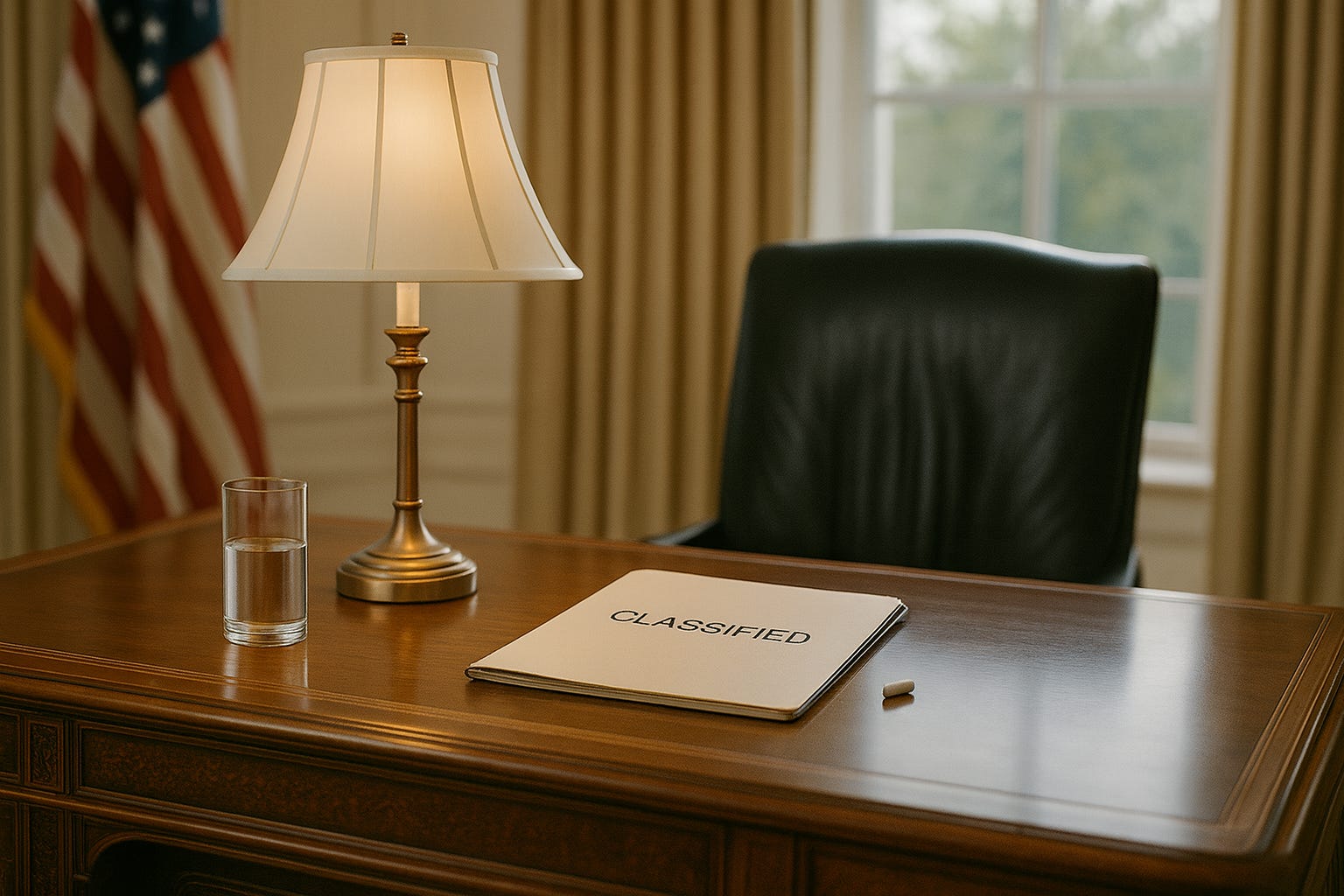
Author’s Note
A psychological satire. Entirely fictional.
In Part I, they gave a president the ability to feel.
In Part II, the world learns what feeling can do.
Part II - The Broadcast
Copenhagen — Presidential Arrival, Christiansborg Palace
Cold Scandinavian light washed the courtyard as the motorcade stopped, one black SUV at a time. Engines idled, the low rumble bouncing off the old stone walls. The air smelled like rain that hadn’t fallen yet.
A row of identical vehicles lined the cobblestones—black, polished, opaque. Their reflections shivered in thin puddles.
Cameras along the press rail clicked in bursts. Danish security stood motionless, hands folded, eyes scanning. European restraint—measured, quiet, exact. No cheering crowds. No chaos. Just order.
Which made what was about to happen feel impossible.
The rear door of the lead SUV opened. A Secret Service agent stepped out first—tall, expressionless, scanning rooftops and balconies in smooth, practiced arcs. Another followed, touching a finger to his earpiece, giving a short nod.
Then the President stepped out. Jaw locked. Shoulders squared. Coat unbuttoned by choice. He didn’t button coats. He didn’t show any weakness.
Marcus Hale came next, briefcase in hand, eyes on the angles—the press, the crowd lines, the Danish flags rippling under the gray sky.
Dr. Adrian Cole followed, coat collar turned up, keeping a deliberate distance. The air felt heavy, metallic, like static before a storm.
At the far end of the courtyard, the doors of Christiansborg Palace opened. A red carpet stretched toward them—bright, ceremonial, almost theatrical.
The engines fell silent, one by one. The courtyard held its breath.
They walked in silence until Marcus leaned closer.
“You see it too?”
Cole’s eyes stayed forward. “He’s… different.”
“Since when?”
Cole paused. “Since the pills started working.”
Marcus didn’t respond. He didn’t need to. The sound of cameras carried their conversation for them—each flash a silent confession.
They walked toward the steps.
And then she appeared.
The Prime Minister of Denmark stepped forward to greet them—calm, poised, sincere in a way that didn’t look staged. She offered her hand to the President.
He took it.
And then something happened that should never happen to a man like him.
He felt something.
Not much. A tremor. A pulse. A human connection too faint to name—but undeniable. Warm eyes. Simple welcome. Zero hostility.
He didn’t know what to do with that.
“Welcome to Denmark,” she said. “I hope the journey wasn’t too hard on you.”
He blinked once. “I don’t—travel well,” he confessed.
Marcus froze. Off-script.
The Prime Minister gave a slight nod. “Long trips can be brutal. We appreciate you making it.”
That—was the trigger—no angle in her voice. No strategy. Just something human.
Cole saw the tell: a pulse under the skin—faster onset. Marcus smelled danger.
The Prime Minister motioned toward the palace steps. “Shall we?”
He opened his mouth to respond—but what came out wasn’t on any memo.
“It’s beautiful,” he said quietly.
She paused. “Copenhagen?”
He shook his head. “Your country.”
Marcus stepped forward. “We should begin—”
But the President kept talking, slower now, like someone relearning language.
“Some places… You feel them before you understand why.”
The wind moved through the courtyard. Danish officials waited, still as glass. The press leaned forward. Everyone felt it—something was off.
He didn’t move toward the entrance. Still holding the Prime Minister’s hand, he just stared—like trying to solve something unseen.
Marcus whispered, urgent. “Sir, let’s move inside—”
He didn’t. “Do you ever think about belonging?” he asked her.
The Prime Minister hesitated. “I’m not sure I understand—”
“Some places feel like they should’ve been yours,” he said, voice breaking. “And it hurts. Because you know you would have taken care of them.”
Marcus signaled: cut the feed.
He didn’t.
“I would have taken care of it,” he said. “Of—Greenland.”
A breath caught somewhere behind the cameras. Even the wind seemed to stop.
A Danish agent shifted, then froze at a quiet command.
The Prime Minister tried to withdraw her hand. He didn’t let go.
Isabel moved, but Marcus stopped her—one more minute.
The President’s eyes filled. “I didn’t want it for power. Or oil. Or bases. I wanted it because some things feel like home. Even when they’re not yours.”
“Mr. President, perhaps we should—”
He stepped forward—and hugged her.
Not a diplomatic embrace. A desperate one.
The cameras erupted.
She stood rigid. Scandinavian discipline against American collapse. He held on too long.
When he finally pulled back—eyes raw—he said, “It’s not about power. It’s not about strategy. I want Greenland… so desperately.”
The courtyard went still.
A superpower had just begged for another nation’s land—on live television.
Across the world, translators stopped mid-sentence. Markets froze. Governments searched for language that didn’t exist.
For one suspended moment, time itself held its breath—watching a man come undone.
Even history looked away, ashamed to witness what feeling had done.
Somewhere behind the cameras, a Danish guard whispered, “Gud hjælpe os…”
“Cut the feed,” Marcus ordered.
Too late.
The world had already seen it.
Three Days Later — White House Residence, 2:14 a.m.
The house slept. One light stayed on.
Margaret “Maggie” Ellison moved through the upper hall the way only someone who’d done it for fifty years could. Senior steward of the Executive Residence. Keeper of the building’s private life. She had arrived as a teenager in the Nixon years, stayed through scandal, assassination attempts, wars, and funerals—and somehow outlasted them all.
She remembered Nixon’s sleepless pacing, the muttered phone calls in the dark; Reagan’s gentle confusion when names slipped away like dust; Clinton’s whispered secrets behind closed doors, the staff learning to keep their eyes down.
She wasn’t part of any administration. She was part of the house.
And the house trusted her.
Down the corridor, another light burned behind a locked door.
Inside, the President moved through the dark like a man searching for something he wasn’t supposed to want. His reflection slid across the glass of the cabinets, sharp and hollow-eyed. Not sick. Not weak. Just… fracturing.
He reached the small, secure room adjacent to the private bedroom suite. Cole kept his medical case in here—locked, controlled, inventoried. No one else ever entered this room.
Except him.
He pressed his thumb to the biometric lock. Green light. Door opened.
He walked to the brushed-steel case on the table. Professional. Precise. Cold. He didn’t need a password to open it; the override was a presidential privilege no one admitted existed.
The case unlatched with a soft hydraulic sigh.
Rows of sealed vials. Blister packs. Syringes. A quiet army of things designed to heal, regulate, or break.
He found what he was looking for.
The capsule sheet.
Same design as before. Same compound Cole claimed to control. Cole was wrong. Nothing controlled this anymore.
He peeled back the foil and removed two capsules.
His hand hesitated.
Only for a second.
He swallowed both dry.
He waited.
The silence thickened. For a moment—nothing.
Then it came.
A warm pulse under the ribs. Then another. Stronger. A pull. A need.
Not chemical.
Human.
He inhaled.
He could feel her again—the Danish Prime Minister. Her voice. Her kindness. The shock of someone meaning what they said. It wasn’t about her. It was about what she opened.
Connection.
He wanted it back.
He needed it back.
A new thought formed—dangerous and clear:
Maybe this is who I was supposed to be.
A floorboard creaked behind him.
He turned sharply.
Maggie Ellison stood in the doorway, holding a stack of neatly folded towels. She didn’t flinch. Didn’t gasp. Didn’t pretend she hadn’t seen what she saw.
Her voice was calm, almost gentle.
“Long night, sir?”
He stared at her, pulse still climbing. Most people scattered when they were caught doing something they shouldn’t have been doing. But Maggie Ellison had been in this house for fifty years. She’d seen too much of power to be afraid of it.
“You shouldn’t be in here,” he said.
She gave a small, knowing smile. “I’ve been told that before.”
He closed the case, too late. Her eyes moved to the two empty blisters on the foil strip near his hand. She didn’t react—but she didn’t look away either.
He waited for judgment. For threat. For leverage. Instead, she set the towels down and spoke as if she were reminding him of the weather.
“You’re not sleeping.”
It wasn’t a question.
He didn’t answer.
“You’re not the first president to walk this house at night,” she said. “I used to see one of them sitting in the East Room by himself. Same time every night. Looked like he was waiting for someone who never came.”
“I’m not waiting for anyone,” he said.
Another small smile, tired but kind. “Everyone is, sir. That’s the trouble.”
He didn’t want this conversation. He didn’t want her here. He didn’t want anyone seeing him like this—not unarmored, not unsettled, not almost human.
He moved to leave the room.
She didn’t move out of the doorway.
“Mr. President,” she said quietly.
He stopped.
She didn’t stare at him the way staff did. She didn’t fear him the way politicians did. She saw him—with the same unsettling clarity Isabel had. And it unnerved him more than any reporter, opponent, or enemy had in years.
“Whatever you’re looking for in that case,” she said, “it won’t give you what you really want.”
His jaw clenched. “And what do you think I want?”
She didn’t blink.
“To feel less alone.”
The air left the room.
For a moment—just one—he looked like he might break again. Worse than in Mexico. Worse than Denmark.
He straightened, the softness gone from his face.
“I don’t get lonely,” he said.
She nodded once. Not agreeing. Just letting him lie.
“Of course not,” she said. “No powerful man ever does.”
He moved past her—but she spoke one last time.
“Be careful with whatever that is,” she said. “This house… has a way of taking from men who think they’re in control.”
He paused.
Then he walked away, shutting the door behind him.
Maggie stood alone in the quiet.
She picked up the foil packet he had dropped—and noticed something.
When she held it to the light, she saw it: a warning label printed so small most people would miss it.
NARCISOL
SIDE EFFECT: PERSISTENT EMPATHIC REORGANIZATION POSSIBLE.
USE WITH CAUTION. EMOTIONAL DEPENDENCE MAY OCCUR.
She stared at it for a long moment.
Then she whispered to the empty room:
“Oh… sir. What have they done to you?”
Four Days Later — Aboard Air Force One
Y.M.C.A.” blasted down the executive aisle, rattling glassware. Staff clapped. Someone tried a conga line. Marcus Hale had ordered it. They were en route to Ohio, the first rally since Copenhagen.
“Morale boost,” he’d said.
It sounded like denial dressed as celebration.
Maggie Ellison wasn’t clapping.
She stood near the galley with her hands folded, a quiet figure in a storm she had seen before. Noise was never just noise. It was a shield. A countdown.
Up in the private forward cabin, away from music and manufactured morale, he stood alone. Backlit by a single lamp. Staring at his own reflection in the window—dark outside, darker inside.
He reached into his jacket and pulled out two capsules.
He knew he shouldn’t. Cole would talk about dosage schedules, neural stability, risk factors. But Cole didn’t understand.
The drug didn’t make him weak.
It made him real.
He swallowed both pills dry.
This time, the hit was fast. A glowing pulse under the ribs. A shiver behind the sternum. Heat—not physical, emotional. Contact.
A memory flickered. A face, a tone—something human he couldn’t name.
Another memory hit—harder.
An office hallway years ago—the woman he destroyed because he could. Her voice shaking: “Why do you hate people who can’t hurt you back?”
He inhaled sharply.
He wanted more.
He tore another blister strip from Cole’s locked case—two more capsules.
Swallowed.
Down the executive aisle, “Y.M.C.A.” kept thundering. Staff yelling, clapping, performing happiness.
It’s fun to stay at the Y.M.C.A…
The lyric bounced off glass and marble — joy weaponized, rhythm without soul.
Maggie’s eyes were no longer on them.
They were on the door to the forward cabin.
She could feel it before it happened.
Something was breaking.
This time, the drug arrived like lightning. Heart pounding with contact. Breath too fast. Too shallow.
Cole stepped into the cabin—calm, surgical. He saw the empty foil on the desk. Then the President’s eyes. He nodded once.
Overdose.
Marcus walked in behind him, annoyed. “We need final lines for the rally, he can’t just—”
He saw. The blood drained from his face. “Jesus Christ.”
The President tried to stand up—and nearly went down. Cole caught him.
“Stay with me,” Cole said. “How many did you take?”
“Enough,” he said, jaw tight, defiant even now.
Cole checked his pulse. Too high. Skin cold. Pupils dilating.
“Answer me. How many?”
“I needed more,” he said. “I needed to—” He grabbed Cole’s shirt, desperate. “I needed to feel.”
His voice broke on the last word.
His legs went.
Cole and Marcus got him to the floor. He fought them—reflex, not choice.
“Airway’s closing,” Cole said. “Oxygen. Now.”
Marcus snapped into action. “No cameras. Nobody outside this cabin hears a word. Move.”
Cole tore open the med kit. “I need vitals!”
A voice appeared in the doorway. Soft. Human. Out of place.
“Dear God—”
It was Maggie Ellison.
She saw him on the floor—saw something no one else saw. Not a president. Not a symbol.
Just a man finally breaking under the weight of himself.
Isabel shoved past Marcus and dropped to her knees.
“Dad—Dad—look at me—”
He tried. For a moment, he saw her. Really saw her.
And that hurt most of all.
Cole forced an oxygen mask over his face. Marcus hit the cockpit button.
“Divert.” His voice cracked. “Now.”
Air Force One banked hard.
Down the executive aisle, “Y.M.C.A.” kept thundering. Staff were clapping. Someone yelled, “Ohio, here we come!”
Cheer as camouflage. The soundtrack to collapse
Walter Reed National Military Medical Center — ICU — 3:42 a.m.
The monitors hummed in the half-dark—slow beeping. Oxygen whispering. A curtain stirred in the low draft from the vent. Outside in the hallway, two Secret Service agents stood guard. Inside, the world had narrowed to a single room—one bed.
He lay still. Too still.
No fever. No pain. No emotion.
The drug was gone.
Isabel sat in a chair beside him, elbows on her knees, staring at the floor—not crying, not blinking much, just holding herself together by force. She hadn’t left the room except to argue with doctors who wouldn’t tell her anything.
Maggie Ellison sat across from her, hands folded. Quiet. Present. She did not speak unless words earned their place in a room. She had seen presidents in hospital rooms before—bullet wounds, heart attacks, breakdowns, one resignation. But never a man overdosing on feeling.
“I don’t understand,” Isabel whispered. “Thirty-six hours ago, he was fine.”
Maggie looked at her gently. “No. Thirty-six hours ago, he was still hiding it.”
Isabel looked up—sharp. “Hiding what?”
Maggie didn’t answer. Not yet.
The door opened. Cole stepped in with a clipboard, tired but focused. His face gave nothing away.
“How long until he wakes up?” Isabel asked.
“He’s conscious,” Cole said. “He’s been drifting in and out. Rest is good.” He checked the IV—steady line. “Withdrawal is worse than overdose.”
“Withdrawal from what?” Isabel asked.
Cole didn’t answer.
Her voice hardened. “What did you give him?”
“Something that made him feel,” Cole said.
“That’s not medicine,” she said. “That’s cruelty.”
“Feeling isn’t cruelty,” Cole said. “Feeling is consequence.”
Before Isabel could answer, Marcus entered, closing the door behind him.
“From now on, there are no more medical experiments, no more emotional diagnostics. He reacted to altitude and exhaustion. That’s it. That’s the line.”
“That’s a lie,” Isabel said.
“That’s survival,” Marcus shot back.
Maggie spoke softly. “Survival and lying are not the same thing.”
Marcus turned toward her. “In this house,” he said, “they are.”
A monitor blipped once—rhythm shift.
The President’s eyes were open.
Not fully. Not loudly. But open.
Isabel leaned forward. “Dad?”
He didn’t speak. Just watched her.
Marcus moved closer. “Sir, everything is under control. You’ll be back on schedule soon. We’ll handle the story—”
The President blinked once, looked at Marcus, and said his first two words since collapsing.
“Don’t lie.”
He rose, restless. He couldn’t sit. Couldn’t lie down. Couldn’t be still. His body moved like it was rejecting something—reality, maybe. He paced the length of the room, dragging the IV pole with him like a chained animal.
“I remember everything,” he said, jaw locked. “Every goddamned second of it.”
Cole stood between him and the machines. Marcus stood between him and the narrative. Isabel stood between him and pain. Only Maggie just… stood with him.
“Your system is clearing the compound,” Cole said carefully. “Emotional latency will pass.”
“Latency,” he repeated, smiling without humor. “You call it latency. I call it a fucking lobotomy.”
“You’re experiencing withdrawal,” Cole said. “You’ll stabilize.”
“No,” he said. “Because I know what it feels like now.”
He looked at Marcus. “Has he told you that part? Did any of you hear that part? I fucking felt something.” He tapped his own chest hard. Once. Twice. “Right here. For the first time in my life, I was more than strategy.”
Marcus didn’t blink. “Then we’ll build from that. Slowly. We’ll manage the recovery. We control narrative—”
“Shut up,” he said, calm, deadly. “Don’t you dare talk to me about narrative. You don’t care if I live or die as long as the numbers hold.”
Marcus went still.
He turned on Cole. “And you. You lit the fuse and ran calculations while I burned.”
“You asked for the treatment,” Cole said.
“I asked to win,” he said, stepping closer. “You gave me something else. You opened something in me—and then you ripped it back and told me to breathe through the hole.”
His breathing picked up. Anger came off him like heat.
Then, in the half-light, he caught his reflection in the window—a pale face framed by machines, eyes rimmed red, IV lines trailing like wires.
For a heartbeat, he didn’t recognize it.
He stepped closer to the glass.
“That’s what you made,” he said quietly. “A man who feels—and still doesn’t know who he is.”
The reflection didn’t blink.
He did. Once. Then turned back.
“I don’t want speeches,” he said. “I want the drug.”
“No,” Cole said.
He didn’t shout. He didn’t threaten. Something worse happened—his voice went quiet.
“You think you’re protecting me. You’re not. You’re killing me slow.” He pointed at his chest again. “It’s empty now. I can feel the emptiness. Do you understand that? I didn’t even know it was there before, and now I can feel it like a fucking wound.”
He looked from Marcus to Cole—and dismissed them both.
Then he turned to Maggie.
Everything in him—the fury, the desperation, the need to be seen—focused.
“Maggie.”
She stepped closer. No fear. No shrinking. Just presence.
He searched her face.
He didn’t ask Marcus. He didn’t ask Cole. He didn’t even ask Isabel.
He asked her.
“Am I crazy for wanting it back?”
The room stopped breathing.
Maggie looked at him—not as a president, not as a monster, not as a problem. As a man in pain.
Her voice was soft. Steady.
“No, sir,” she said. “You’re not crazy. You just finally learned what loneliness feels like.”
Something in him broke—not loudly this time. Quiet. Internal. Structural.
He closed his eyes once, just once, like someone absorbing a blow.
Then he opened them.
Hard again.
Cold again.
Decision made.
He turned slightly, enough to catch Cole’s reflection in the dark glass.
“I’ll need another dose,” he said. Calm, deliberate. “The same formulation.”
Cole didn’t move. “It’s not authorized,” he said.
He smiled, small and patient. “Authorization is a flexible concept.” He leaned in, voice low and precise. “You’ll prepare the same formulation,” he said. “If you don’t, tomorrow your name opens every story. Malpractice, complicity—the works. I decide how small you get.”
Cole’s throat worked. The hum of the machines filled the room like static. He looked at the floor, then up at the man he had tried to help.
He nodded once.
After that, there was no drama—only the quiet, efficient mechanics of access being arranged.
He stepped past Cole. Past Marcus. Past the IV line, tugging at his arm.
“Nobody stops me from getting it back,” he said. “Not you. Not him. Not anyone.”
“Sir—” Cole began.
He didn’t turn back.
“This country wants a leader?” he said. “Then they’ll have to live with what it takes.”
He walked out of the ICU.
Not healed.
Not recovered.
Rearmed.
And that was worse.
The White House — West Wing
He walked the corridor like nothing had happened. No limp. No hesitation. No apology.
If anything, he looked stronger—sharpened.
The kind of calm that made people step out of his way without knowing why.
Staff froze as he passed. Not out of fear. Not respect. Something worse: uncertainty. No one knew which version of him had returned — the weapon, or the man who’d cried in Copenhagen.
He passed a row of polished glass panels, and for a moment his own reflection kept pace beside him—pale, sleepless, faintly luminous under the corridor lights.
It looked almost human.
Then the light shifted, and it was gone.
Marcus Hale kept pace beside him, voice low, rehearsed.
“We’ll do this clean—short reentry window. You’ll be seen working, seen active, seen unbroken. Optics will kill the ICU story.”
He didn’t respond.
“We’ll stage a bill signing today,” Marcus continued. “Couple of camera ops. Stable, presidential—”
“Schedule a broadcast,” he said.
Marcus blinked. “Broadcast?”
“National address.”
Marcus recovered. “Okay. Thirty-second clip? Social video?”
“Live,” he said.
Marcus stopped walking. “You want a live national address?”
“Tomorrow night,” he said.
“About what?”
He opened the door to the Oval Office. Paused just before stepping inside.
“The truth.”
Oval Office — Night
The room was cut into hard shadows by a single lamp. He stood behind the Resolute Desk—not tired, not recovering, but dangerous again.
The kind of controlled dangerous that made people remember why they feared him.
Marcus Hale stood near the doorway, pale with political dread. Isabel watched from the edge of the room, arms crossed, trying not to shake.
Maggie sat near the window, silent, witnessing. She had watched presidents break in this room before.
The house had seen men slip.
But it had never seen a man come back looking like this.
“This is a mistake,” Marcus said. “You go live now, you lose control of the message. You’ll spook donors. You’ll fracture the base. You want to take action—fine—but we need strategy—”
“Strategy,” the President said slowly, “is why people like you never win anything that lasts.”
He didn’t raise his voice. He didn’t have to.
“You’re all terrified of tomorrow because none of you know what to do without me telling you.”
Marcus opened his mouth, but nothing came out.
“You are afraid men like me walk away,” the President said. “But worse—you’re afraid men like me wake up. Because if we wake up, men like you become irrelevant.”
“If this is about revenge—” Marcus tried.
“Revenge is petty,” he said. “Petty hasn’t interested me in years. This is about correction. Balance.”
Isabel stepped forward. “Balance how? By threatening people? Destroying them?”
“By holding them accountable,” he said. “Tomorrow night, the country hears truth. Real truth. Not the version with teeth filed down to comfort cowards.”
“What truth?” she asked.
“You’ll hear it with everyone else.”
“Why the secrecy?” she demanded.
“Because none of you have earned anything else.”
“If you burn the system, you burn yourself with it,” Marcus said, last card.
“I built your system,” he said. “I can end it and build another one by breakfast.”
For a moment, the room believed him.
He turned slightly, catching his reflection in the dark window behind the desk.
This time, he recognized it.
He adjusted his tie, studied the face that stared back, and smiled—just enough to see the expression take shape before it reached the real one.
A rehearsal.
A weapon.
Maggie’s voice, when it finally came, was quiet—not defiant, not scared. Just old with truth.
“I’ve seen men in this room think they were bigger than history,” she said. “History always answered back.”
He looked at her—not with dislike, but with recognition.
“History didn’t have me,” he said.
He moved to the door.
“Be ready,” he said. “Everything changes tomorrow night.”
He left them in the dark.
Isabel leaned on the desk like the ground moved beneath her. Marcus stared at the door, realizing too late that for the first time since he met the man—he had no idea what was coming.
Maggie closed her eyes. She could already hear the echo of it—the sound certain men made right before they shattered a world and called it necessary.
Tomorrow night had a pulse now.
The room held its breath.
A red tally light blinked to life.
A producer’s hand rose—five, four, three…
No one said “two.” No one dared.
On “one,” he leaned forward, eyes calm, smile rehearsed to look unrehearsed. The man who never waited for anyone waited exactly one second—then began to speak.
Good evening, my fellow Americans.
Tonight, I want to speak to you — not as your President, but as a man who’s seen and felt more than he ever expected to.
They say I’ve changed.
They’re right. I have.
I’ve seen things. Felt things.
They used to say I didn’t have a heart.
Now they say it’s too big.
Maybe I cry. Maybe I do.
For you. For me. For everyone who’s never had a president who felt this much.
Here’s what I’ve learned: feeling is stronger than fear.
Fear makes people obey.
Feeling makes them believe.
And belief — that’s the real power.
We’re entering something new. I call it The Era of Recognition.
Because now I see everything. Everyone. Every tear. Every face.
And I can move them all.
They tell me not to say this. They say it sounds dangerous.
It isn’t. It’s honest.
And honesty — when you finally feel — can be devastating.
So here’s my promise:
I will lead not just with strength, but with heart.
And my heart — believe me — is enormous.
Those who love this country will feel it.
Those who don’t — will feel it too.
Maybe a little differently.
Together, we will make America feel great again.
And when America feels, the world listens.
Thank you.
God bless you.
And God bless the United States of America.
Cole watched the replay alone in his quarters, the room lit only by the screen’s blue glow.
No analysts yet. No pundits. Just silence—the kind that comes before history decides what it thinks it saw.
On the monitor, the President froze mid-smile. Eyes bright. Voice soft. Dangerous.
They would call it transformation.
They would call it healing.
They would call it the night the nation “learned to feel again.”
Cole knew better.
Narcissists don’t die when they feel. They mutate.
Empathy hadn’t humbled him; it had upgraded him.
He’d learned the grammar of emotion—how to turn apology into applause, compassion into currency, sincerity into command.
Fear used to move people. Now he could move them with tears.
That made him invincible.
That made him worse.
On the screen, he was still speaking, voice warm, tone intimate, promising love like a weapon:
“We make America feel great again.”
The crowd in the broadcast roared—not in anger, but in recognition.
Cole leaned closer.
He saw it now—the perfect hybrid: cruelty with conscience, dominance disguised as care.
It wasn’t propaganda anymore; it was affection, monetized and televised.
He closed the laptop. The screen went black, reflecting only his own face—small, hollow, and afraid.
But faintly—almost invisibly—another reflection hovered behind his: the President’s frozen smile lingering on the glass, a ghost of light that refused to fade.
Cole stared at it until his eyes blurred.
“God forgive us,” he whispered. “We didn’t cure him”.
“He adapted.”
He sat there a long time, listening to the faint echo of his own heartbeat against the hum of the building.
Around the world, screens replayed it again and again — a leader who had experienced empathy and learned to use it, and a people grateful to believe him.
Cole rubbed his eyes, but the afterimage of that smile stayed burned on the inside of his lids.
“God help us all,” he said softly.
“The monster finally found his heart.”
Author’s Note
Entirely imagined. Yet the question remains:
What’s more dangerous—a leader without empathy,
or one who knows how to fake it?