The Last Acceptable Death
On when death became something we no longer tolerate

It happens quickly.
A man stops walking.
Not dramatically. Nothing that would draw attention from a distance, or even register at first as wrong.
He slows, just slightly, as if reconsidering something small. A step shortens. Another.
Then the structure that was holding him upright gives way.
Not violently. Not even awkwardly.
Just a quiet, almost orderly loss of balance.
For a moment, no one moves.
Then someone nearby notices.
By the time a doctor arrives, there is already very little to be done.
He is pale.
Pulseless.
Still warm.
The doctor kneels and listens.
Not because he expects to hear anything new, but because this is where listening belongs.
There is no rhythm to interpret. No monitor. No enzyme. No artery to open—
nothing that becomes action.
He waits a little longer than necessary.
Not out of uncertainty. Out of habit. Leaving too quickly feels abrupt. Staying, just a few seconds more, keeps the shape of effort.
Then he stands.
“He is gone.”
And that is the end of it.
A century ago, this was not unusual.
Sudden death, what we would now call cardiac arrest, was part of the visible fabric of life. It happened in the streets, at home, at work. Often without warning.
Almost always without intervention.
There were no ambulances equipped to reverse it. No defibrillators. No coronary care units.
And so it was described differently.
Not as a failure of response.
Not as a system that didn’t arrive in time.
Just something that happened.
Final. Immediate. Understood, if not explained.
Physicians of that time were not indifferent.
William Osler wrote about sudden death with clarity, even restraint. He recognized its patterns, its unpredictability, its tendency to arrive without negotiation.
But there was no real sense of control.
The limits of medicine were visible. Daily.
A stopped heart was not a problem to be solved.
It was an ending.
Something shifted.
Not all at once. Not cleanly. But steadily enough that it’s hard, looking back, to see where it began.
First came the ability to see the heart’s rhythm—the electrical trace, captured in lines and intervals.
Then the realization that some deaths were not instantaneous, but transitional.
That between life and death there is a narrow space, unstable, brief—and that within that space, something might still be done.
The development of Electrocardiography made the invisible visible.
Ventricular fibrillation was no longer a mystery. It was a pattern.
Chaotic. Disorganized.
But recognizable.
And recognition changes things.
Because once you can see a pattern, it becomes difficult not to try to interrupt it.
The defibrillator followed.
Electricity, applied not as observation, but as interruption.
A shock—deliberate, external, indifferent to the body’s own rhythms.
Not subtle. Not natural.
But sometimes effective.
Enough to change expectations.
Then came systems.
Coronary care units began to gather the unstable into places designed for intervention. Emergency medical services extended that effort outward, into streets, homes, and public spaces. Protocols followed—structured, repeatable, increasingly precise.
A collapse in the street was no longer something that simply happened and ended.
It became the first moment in a sequence.
Something that could still unfold.
And with that, something quieter shifted.
Death, which had once been immediate and accepted, became provisional.
A state to be challenged.
Something to work on.
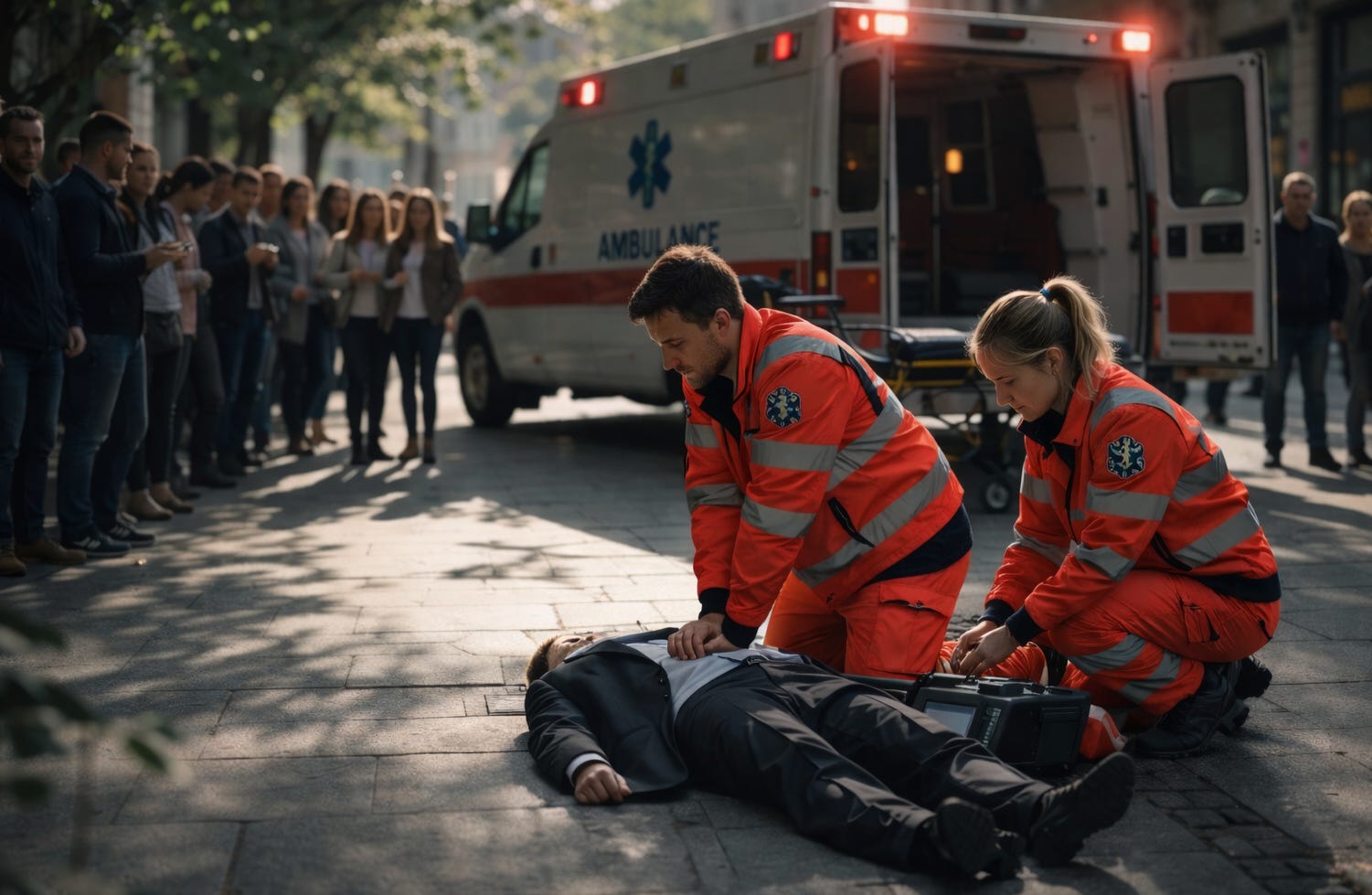
Today, when a man collapses, the sequence is different.
This time, it is not unnoticed.
Someone calls for help. Voices overlap, then settle into something like urgency.
Hands appear—hesitant at first, then more certain.
Weight comes down. Rhythm imposed.
Not gentle. Not careful.
The chest yields.
A device is brought forward. Pads pressed against skin that is still warm.
“Stand clear.”
The shock is delivered.
There is a brief stillness—not the natural kind, but something imposed.
Then movement resumes.
And sometimes, it works.
The heart resumes.
Circulation returns.
A life, interrupted, is pulled back—if not fully restored, then extended into something that still resembles itself.
That matters.
But not always.
And when it doesn’t, the tone is different.
There is documentation. Timing. Interventions. Decisions—each step recorded with a precision that suggests control.
The question is no longer simply what happened.
It is also:
Was enough done?
There is a difference now.
Before, the doctor confirmed death.
Now, he argues with it.
And when he loses, something doesn’t quite settle.
Not only what happened.
But whether it could have been otherwise.
Modern medicine has extended life in ways that would have been difficult to imagine a century ago.
Sudden cardiac death is no longer always final.
That part is clear.
But something was lost along the way.
Not skill. Not knowledge.
Something harder to name.
There was a time when death arrived without negotiation.
Now it often arrives after effort.
After intervention.
After resistance.
And that changes how it feels.
For families. For physicians. For everyone involved.
Death is no longer simply an event.
It becomes something else.
Measured. Reviewed. Questioned.
And perhaps it has to be.
Because once you know that something can be reversed, it becomes harder to accept when it is not.
But the boundary remains.
Despite everything—every protocol, every device, every attempt—the transition between life and death is still, in many cases, abrupt.
Still resistant.
Still, at times, immediate.
He stops walking.
He folds.
This time, it is not unnoticed.
Someone calls for help. Voices overlap, then quiet. Hands move with purpose now.
By now, the sequence is already in motion—
and already close to its end.
The doctor listens longer than he needs to.
Not for a sound.
For permission.
Nothing comes.
Still, he waits. A few seconds more than the moment requires.
It doesn’t change.
He straightens.
The room is quieter now, but not settled.
“He is gone.”
For a moment, it doesn’t feel like an observation.
Something closer to a decision.