
The Sunday Walk
A story about death, silence, reputation, and what institutions protect.

This is the complete version of The Sunday Walk.
It was first published here in eight weekly episodes. What remains is the story without interruption.
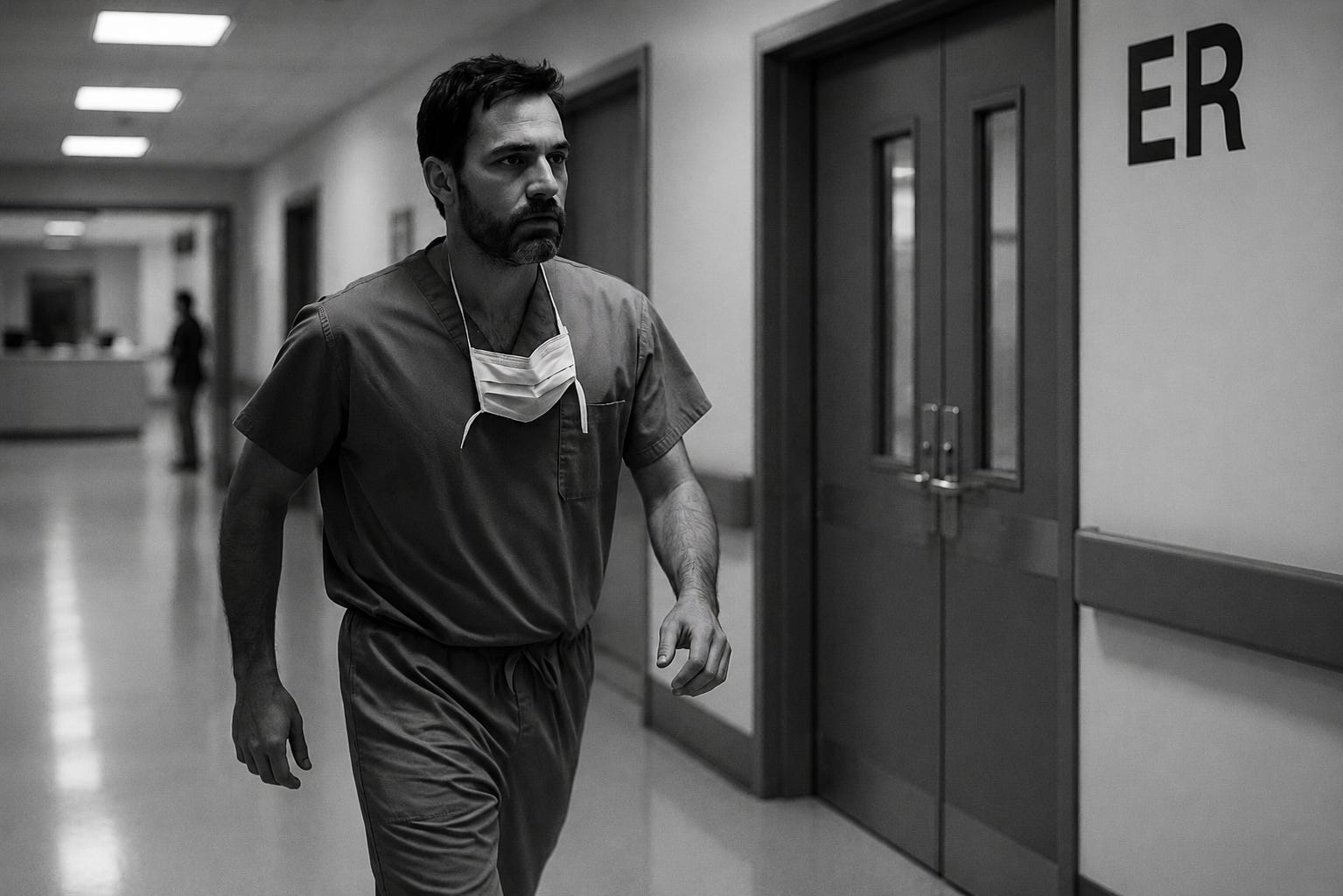
Arrival
They bring him in asystole.
No rhythm. No variation. Just a flat tracing that has already made its argument.
Compressions continue as they move him from stretcher to bed. Their hands move with mechanical steadiness. They have done this too many times to think about it. The muscles remember.
“Male. Mid-fifties. Found unresponsive. CPR initiated on scene.”
“Downtime?” I ask.
A glance between them.
“Unclear.”
Unclear almost always means too long.
His chest is already bare. He carries the smell of another apartment with him, detergent, something faintly sweet, the private residue of a morning not meant to end here.
“Who found him?”
“A woman.”
“With him?”
“Yes.”
“In bed?”
A nod.
“She started CPR.”
“Relationship?”
A pause.
“Not his wife.”
That is all they say.
It is enough.
We take over.
Hands replace hands. The count resumes. The bag hisses. The monitor remains unimpressed.
Shock.
Nothing.
Medication.
Nothing.
The room settles into its rhythm. Efficient. It is easier when the body does not interrupt you with hope, when nothing on the screen suggests that effort might still negotiate with outcome.
I step closer. I know the face. Not as a patient. As a colleague.
We’ve shared meetings and corridors, the thin familiarity of hospital life. You recognize the posture, the voice, the way someone stands in a doorway, without ever really knowing them.
He is a surgeon. Skilled. Certain. The kind of man who expects the room to listen.
I also know his wife.
I know her better than I know him.
We went to school together. Not closely, but long enough for memory to have texture. She was brilliant even then. Quiet, but never hesitant. The kind of intelligence that made teachers lower their voices when they spoke to her.
Later, her name appeared again, papers, conferences, appointments that mattered. Biochemistry. Toxicology. Work that lived far from my world, but close enough that I recognized its seriousness.
The recognition settles heavily.
We continue.
Shock.
Nothing.
The paramedics stay longer than necessary. A small kindness. Eventually, the repetition stops helping and just becomes a routine.
I say the time.
My voice holds.
The room resumes its ordinary shape. Equipment is cleared. The bed returns to neutrality.
One of the paramedics lingers.
“Doctor,” he says quietly. “She asked if he’d be okay.”
“And?”
“I told her we were doing everything.”
We always are.
She did not come with the ambulance.
No one waits in the corridor. No family pacing. No collision of grief and explanation.
Just a body delivered from the wrong life.
I turn back to the chart and begin writing the details.
Under emergency contact, her name is already there. It does not surprise me. What surprises me is how long I hesitate before reaching for the phone.
Because I know her.
The line begins to ring in my hand before I realize I’ve pressed it.
I already know that whatever I say first will become the official version of events.
The Walk
She wakes before him.
Not because she has to. Sleep releases her early now. The light at the window thins.
She lies still and listens to his breathing. Even. Certain.
In the kitchen, she makes coffee quietly. The machine clicks. She pours two cups, sets one where he will find it, and keeps the other in her hands.
He comes in already dressed.
“You’re up,” he says.
“So are you.”
He shrugs. “I walk better before the city wakes.”
It sounds reasonable.
“I’ll be gone a couple of hours,” he says, taking the cup she made. He tastes it. A faint crease at his mouth.
“Still too strong.”
She smiles. “You say that every time.”
“And every time I’m right.”
He leans against the counter and checks his phone.
“You working today?”
“Just reading,” she says. “Trying to stay ahead.”
“Of course you are.” A nod. Approval, almost. “You’re good at that. Staying ahead. On paper.”
She waits, just long enough.
“In the lab,” he adds lightly, “things do what you tell them. People are messier.”
She laughs first.
It comes quickly, before the moment has time to settle.
“I’ll be back before lunch,” he says, already moving toward the door. “Don’t wait.” He says it gently. As if it were kindness.
At the door, he pats his pockets.
“Keys.”
He finds them.
He doesn’t kiss her goodbye. He rarely does on mornings like this.
She watches him step outside. The door closes softly.
The apartment feels larger.
She sits at the table with her coffee. It is too hot. She keeps her hands around it anyway.
His cup remains half full on the counter.
She considers rinsing it. Leaves it.
Outside, he settles into a steady pace. He values the first stretch, the part where no one expects anything.
He thinks about her conference. Reykjavík. Nordic toxicology. A dinner he has already decided not to attend.
“They won’t notice,” he told her once. “You’ll be in your element. Slides. Data.”
She nodded.
He adjusts his jacket. Keeps walking.
He believes he has time.
The Apartment
She has been awake for some time when he arrives. Not pacing. Not anxious. Just alert.
She adjusts the sheets once more before he knocks. Smooths the fabric. Aligns the pillow.
When he steps inside, he carries the morning with him, cool air, steadiness, the sense that he belongs wherever he stands.
“You’re early,” she says.
“I walk fast,” he replies.
They sit first. They always do. She values this part. It makes the rest feel earned.
He talks about the hospital. A junior doctor who challenged him during rounds.
“She meant well,” she says.
“That’s the problem,” he answers lightly. “Confidence without hierarchy is exhausting.”
He smiles when he says it. It almost sounds like a joke.
She studies his face, trying to decide if it is.
He notices.
“What?” he asks.
“Nothing.”
He reaches for her hand, briefly. Not to hold it. To redirect the moment.
“She overthinks things,” he says, returning to the junior doctor. “Like someone else I know.”
It lands gently. Precisely.
She lets it pass.
When she mentions his wife, it is casual. Measured.
“How is she? Preparing for the conference?”
“She’s always preparing,” he says. “That’s what she does.”
“Must be important,” she says.
“It is,” he replies. “To her.”
She has asked him before whether his wife knows about her. He has answered the same way each time.
“We’ve moved past that stage,” he once said. “Marriage evolves.”
She chose to believe him. Not because she is foolish. Because the alternative required more from her than she was willing to give.
When they move to the bedroom, he undresses with the same composure he brings into an operating theatre. Efficient. Controlled.
He lies back and closes his eyes.
“Long week,” he says.
She watches his face. There is something in it she does not name. Fatigue, perhaps.
“You should slow down,” she says.
“I’ll slow down when there’s something worth slowing for.”
He opens one eye when he says it, as if checking whether it lands.
She smiles.
She adjusts, as she usually does.
Then something shifts. He inhales. Does not complete the breath. She thinks, at first, that he is pausing deliberately. Testing her.
She says his name. No response. She leans closer. Touches his shoulder. His skin is already cooler than it should be.
She says his name again. The silence changes. She moves quickly.
Phone in one hand. The other pressing against his chest. Counting without rhythm. Her voice is steady when she gives the address.
They ask who he is. She gives his name. They ask if she is his wife. She hesitates.
“No.”
The word feels heavier than she expects.
She does not add anything else.
When the paramedics arrive, the room changes temperature. Equipment replaces air. Movement replaces uncertainty.
One of them guides her aside. She obeys.
She watches them work on him with professional eyes. She notes the compression depth. The ventilation timing. The absence of response.
She knows enough to understand what that absence means. When they leave with him, she remains seated. The apartment is suddenly very quiet.
On the chair, his jacket hangs carefully folded. On the bedside table, her phone screen still glows. She turns it face down.
The Wife
She arrives alone.
Not rushed. Not composed either. Simply present, as if she has already crossed something before entering the room.
I recognize her immediately.
We say each other’s names. Nothing else. We sit.
I tell her what happened.
Cardiac arrest. Resuscitation attempted. No response.
She listens without moving.
“Was it sudden?” she asks.
“Yes.”
She nods.
A pause.
“Did he suffer?”
“No.”
She closes her eyes briefly.
Then she opens them again.
Another pause.
“Where was he?” she asks.
I look at her.
“At an apartment,” I say.
She takes that in.
“Was he alone?”
“No.”
She exhales through her nose. Slowly. Controlled.
I wait.
“Was she with him?” she asks.
“Yes.”
A longer pause.
“She tried to help,” I add. “She started CPR.”
She nods again.
“I thought so,” she says.
She does not explain what she means. She looks down at her hands. They are steady. She places them flat on her thighs, as if anchoring them there.
“You knew him,” she says.
“Yes.”
“And you know me,” she adds.
I don’t correct her.
“That makes this awkward,” she says. Then, after a moment:
“For you.”
“I can manage,” I say.
She studies my face, not searching for information, but for limits.
“I’d like to keep things simple,” she says.
I let the sentence remain unfinished.
“For the children,” she continues. “For people who don’t need details.”
She looks up.
“And for me.”
The room feels smaller.
“He went for a walk,” she says. Not as a question.
“Yes,” I say. “That’s what he usually did.”
She nods.
“Then that’s what I’ll say.”
A pause.
“If someone asks you,” she says, “I don’t expect you to volunteer anything.”
She stops there.
I nod.
It is not agreement. It is recognition.
“There will be an autopsy,” she says.
“Yes.”
“Of course.”
She stands.
At the door, she hesitates. Just long enough.
“He liked control,” she says. “Even when he pretended not to.”
Her voice shifts on the last word. Barely.
Then she leaves.
I remain seated.
Outside the room, the department continues. Phones ring. Stretchers pass. Someone laughs too loudly at the desk.
I return to my work.
The Marriage
She learned early the cost of a sentence.
Not through prohibition, he never forbade her, but through revision. He would tilt his head, smile, and improve her conclusions. He corrected her phrasing until she began to edit herself in advance.
From the outside, this was called harmony.
In the beginning, he used her mind as an accessory. He presented her to rooms with a particular pride.
“Brilliant,” he would say.
“Useless at small talk, but brilliant.”
It was not praise. It was translation. Later, the translation narrowed.
At dinners, he intercepted questions meant for her.
“She works with molecules,” he would say, sipping his wine. “They are more predictable than people.”
She learned the utility of silence.
At home, he framed his dominance as a division of labor.
“You disappear into the lab,” he said. “Someone has to remain practical.”
He said practical the way others said human.
When her professorship was announced, he weighed the word.
“It suits you,” he said. “Just don’t expect it to provide happiness.”
She offered no response. Any answer would simply become material for his next argument.
He was interested in her medication. Not as a husband, but as a technician. “You’re flatter on these,” he noted. “Quieter.”
And later: “Do you think they make you less sharp?”
She did not argue.
She consulted her doctor, adjusted the dosage, and kept the change to herself.
She learned to keep her work intact by keeping it separate. She wrote papers in the hours he was not watching. She attended conferences alone. Once, he accompanied her, and spent the evening explaining her own research to her peers.
She did not invite him again.
Years passed without an event.
No shouting. No visible rupture. Only a steady reduction of the space she was permitted to occupy.
He called his control standards. He called her stillness withdrawal. When she was quiet, he accused her of superiority. When she spoke, he called it defensiveness.
Eventually, his absence became her primary source of oxygen. Not emotional. Physiological.
On Sundays, he walked.
He called it discipline. She understood it as something else. She did not check his phone. She did not ask questions that required answers.
People ask, later, when she first suspected. Suspicion implies a desire to know. She had no such desire.
She observed the gaps in his narrative and chose not to fill them.
She stayed. Not out of loyalty, but out of habit. When he died, the woman was a detail. A footnote.
What surprised her was the relief.
Not joy. Something quieter. A release of pressure. The air in the apartment no longer felt owned.
She tells colleagues he was complicated.
Brilliant.
These are the accepted terms.
At night, she stands in the center of the house and realizes she is no longer being observed. The cage has been left open. She does not yet know whether she wants to leave. Or remain.
The Coffee Room
The coffee room is louder than usual. News travels quickly in hospitals. It arrives stripped of detail but heavy with tone.
I almost turn around when I hear his name.
Instead, I step inside.
Five of them are already there. Cups in hand. The morning not yet settled.
“Unbelievable,” Jón says, too loudly. He is incapable of speaking at a normal volume. “He was operating on Thursday.”
“He looked fine,” someone else adds.
“They always do,” Jón replies.
I pour coffee and keep my back half-turned.
“Massive infarct?” one asks.
“Cardiac arrest,” Jón says, as if he had been present. “That’s what I heard.”
“You hear everything,” another mutters.
Jón grins. “Occupational skill.”
There is a pause. Then the shift.
“So,” Jón says, lowering his voice only slightly, “not at home.”
No one responds immediately.
“At an apartment,” he continues. “With someone.”
A small whistle.
“Christ.”
I say nothing.
“They say she started CPR,” someone says.
“Good for her,” Jón replies. “Wrong place, though.”
A few chuckles.
He leans back against the counter, warming to his subject.
“Typical, though.”
“In what way?” someone asks.
“In every way,” Jón says. “Brilliant hands. Zero impulse control.”
There is more laughter at that.
“He was the best in the theatre,” another adds. “You have to give him that.”
“No question,” Jón says. “You wanted him if something went sideways.”
“And you didn’t want to be a first-year around him,” someone else says.
“Unless you were female,” Jón replies.
The room reacts in fragments, laughter, a cough, a shrug.
“He liked admiration,” Jón continues. “Preferred it young.”
“That’s not a crime.”
“No,” Jón says. “Just predictable.”
I take a sip of coffee. It is too hot.
“And the wife,” someone says carefully.
There is a shift in posture. A subtle recalibration.
“What about her?”
“Poor woman.”
Jón snorts lightly. “Poor? She’s tougher than any of us.”
“She’s quiet.”
“Quiet doesn’t mean weak.”
“No.”
Jón takes another sip.
“He used to joke about her, you know.”
I feel my shoulders tighten before I can stop it.
“What joke?”
Jón smiles.
“He’d say, ‘If I ever drop dead, check the toxicologist first.’”
There is laughter. Not loud. Not comfortable either.
“Jesus.”
“He thought it was funny.”
“Did she?”
Jón shrugs. “She never laughed.”
Silence, brief but real.
“Anyway,” he continues, brushing it aside, “everyone knew he had… arrangements.”
“With who?” someone asks.
“Take your pick,” Jón says. “Residents. A physiotherapist once. Someone from radiology.”
“But this time?”
“No idea.”
“Does it matter?”
“Not to him,” Jón says.
I put my cup down.
“It matters to someone,” I say.
It comes out quieter than I intend. The room shifts toward me. Jón looks at me for a moment, assessing.
“You were on call,” he says.
“Yes.”
“And?”
I hold his gaze.
“And we did what we could.”
A pause.
“That’s not what I meant,” he says.
“I know,” I reply.
Silence settles. Not hostile. Just edged. Jón lifts his hands slightly, mock surrender.
“Relax. We’re just talking.”
“I know,” I say again. I pick up my coat. As I reach the door, I hear Jón add, almost casually:
“Still. If I go like that, at least let it be interesting.”
Laughter follows me into the corridor. I don’t turn around.
The Mistress
She does not sleep.
She lies on her back, eyes open, the room intact around her. The ceiling fan completes one slow rotation after another. She counts once, then stops.
The apartment still smells like him. Not strongly. Not enough to justify the thought. But enough to catch when she turns her head, soap, fabric, something metallic she associates with hospitals more than bodies. She does not open a window.
There are only two pathologists scheduled for autopsies this week. The other two are away. A conference. Sick leave. A rearrangement that had seemed incidental when the rota was finalized.
Now it feels structural.
She knows the case will fall to her. No one has said this yet. No call has come. But the arithmetic is simple.
She tells herself this does not matter. Those procedures exist precisely for moments like this. That transparency is protection.
Still, she does not sleep.
She turns onto her side. The pillow carries the faint impression of another head. She presses her face into it once, then stops.
She thinks of the autopsy room.
The light there is unforgiving, but honest. Stainless steel. Clear surfaces. Nothing hidden unless someone chooses not to look. She has always liked that.
Clarity, to her, is not simplicity. It is the absence of performance.
She met him there.
He had come down to observe a case. One of his former patients. Complications. A death that needed explanation more than blame.
She had known who he was immediately. Everyone did.
He stood too comfortably in the room, as if it were an extension of the operating theatre. Hands loose at his sides. Eyes already anticipating conclusions.
“You’re the pathologist,” he said.
“Yes.”
“You’re young.”
She waited.
“For this,” he added. “Not in general.”
She nodded. It was a familiar correction.
He leaned closer to the table and studied the incision line.
“Clean work,” he said. “Precise.”
“Thank you.”
He looked at her then. Really looked.
“What made you choose this?” he asked.
She had answered without rehearsing.
“I like clarity.”
He smiled. Not unkindly.
“Careful,” he said. “Clarity can be dangerous.”
She had frowned. “How?”
“Once you see things clearly,” he said, “you stop tolerating people who don’t.”
She had not known then whether it was a warning or an invitation. Later, she understood it had been both.
She turns onto her back again.
The smell is still there.
She thinks of his wife. She has never met her. Knows her only by reputation. Papers. Citations. A name spoken carefully in meetings.
Toxicology. The word arrives unbidden and stays longer than it should. She wonders, briefly, whether she should call her.
Not to say anything specific. Not yet. Just to acknowledge the shape of what has happened. To make the silence smaller.
She imagines the call. The pause before the voice answers. The need to explain who she is.
She does not make the call.
She considers going to see her instead. Standing at the door. Saying very little.
That feels worse.
She tells herself there will be time. That nothing requires immediate action. This is not entirely true.
She turns her phone face down, as if it might accuse her of delay.
She thinks of alternatives. She could refuse the case. Cite conflict. Request reassignment.
That would open questions.
Questions do not stay contained.
She could proceed. Document carefully. Let the findings speak.
They always do.
She knows this professionally. She also knows how absence speaks. How a report can be correct and still incomplete.
Her hands rest on her abdomen. They are still now.
She breathes in.
Out.
The ceiling fan completes another rotation.
Toward morning, she sleeps. Not deeply. Just enough to dull the edges.
When she wakes, the smell is weaker.
The decision isn’t.
The Autopsy
The autopsy is scheduled for 8:15.
I arrive on time. She is not there.
The assistant is.
“She’s running late,” he says. “There’s no one else today.”
I nod. I decide to attend. Not out of concern. Not out of doubt. I have known him for years. I was his last doctor. It feels appropriate.
A final professional courtesy.
The room is already prepared. The lights are on. The table is set. Everything is ready except the one person required to begin.
I wait. Ten minutes. Nothing changes.
I ask the assistant to call me when she arrives.
He nods. I leave.
At 9:30, my phone rings.
“She’s here.”
I return.
She is already at the table.
We greet each other briefly. A nod. Nothing more.
She looks as she always does. Perhaps slightly tired. Nothing else is apparent.
The autopsy room is as it always is. Bright. Controlled. Impersonal. The smell of formaldehyde sits lightly in the air.
I know her professionally. I respect the precision of her work. That is the extent of it.
The assistant uncovers the body. He looks smaller under the lights. Greyer.
She begins.
“Male. Late fifties. No external signs of trauma.”
Her voice is steady. Measured.
I observe the procedure.
The opening of the chest is precise. The sequence is familiar.
“Heart enlarged,” she says. “Moderate coronary atherosclerosis.”
She holds the organ a moment longer than necessary.
Then continues.
Lungs. Liver. Kidneys.
Everything described once. Nothing emphasized.
Her movements remain exact. Slightly accelerated.
At one point, she adjusts the instrument tray. It does not need adjusting. Metal touches metal. Briefly.
The assistant continues writing.
When she removes the brain, her cadence becomes more deliberate.
“No intracranial hemorrhage. No mass lesion. Brainstem unremarkable.”
There is nothing dramatic about the process.
“Most consistent with sudden cardiac arrhythmia,” she says.
A brief pause.
“Pending histology and toxicology.”
The assistant writes.
At one point, I find myself watching her face more than her hands.
Not for emotion. For interruption. I do not see anything I can name.
When the examination is complete, she washes her hands.
The water runs evenly.
I hesitate, then ask:
“Did you know him?”
She looks at me.
“Yes,” she says.
A pause.
“We had met.”
It is a small place. Colleagues know each other in fragments. That is enough.
The assistant finishes writing.
She turns back to the table and begins to close the examination.
The movements are identical to the ones that opened it. Reversible. Controlled. As if nothing has occurred that cannot be contained.
We separate shortly after.
Outside the room, the corridor continues as it always does.
The case has entered its next phase.
I have no reason to question anything I have seen.
And nothing that would allow me to.
After
She leaves the autopsy room without looking back.
The corridor is too bright. Too ordinary. People pass her with coffee, charts, laundry. No one looks at her. No one needs to.
She walks faster than she intends. Not enough to notice. Just enough.
At the end of the hall there is a staff bathroom. Beige tile. A sink that never quite empties.
She goes in. Locks the door.
Stands there. Looks at her hands.
Then her stomach turns.
It comes without warning.
She catches the edge of the sink. Bends. The retching is brief. Dry. The body insisting on something that isn’t there.
She stays there a moment longer than necessary. Then lowers herself to the floor. Cold tile through fabric. She doesn’t think about it. Just waits.
Another wave comes. Smaller. Then nothing.
The room settles.
She washes her hands.
Soap. Rinse. Soap again.
The water runs. She lets it. Leans forward. Forearms on porcelain. Breath short. Then longer.
She waits until it belongs to her again.
Something moves through her, the table. The weight. His face.
The sound of bone.
She rinses her mouth. The paper towel comes apart in her hands.
In the mirror, nothing is wrong. Eyes clear. Skin unchanged.
Someone who stepped out for a minute.
That’s enough.
She runs cold water over her wrists. Dries them. Straightens the surgical gown. Smooths the edges that can be smoothed.
Unlocks the door.
The corridor is the same. She adjusts to it. Walks back.
Her office is dimmer. Staler. Papers where she left them. The screen still black.
She sits.
Waits.
Then wakes the computer and opens the file. Not because she is ready. Because the alternative is worse.
Outside, the hospital moves.
Phones. A trolley. Someone laughing too loudly.
She keeps her eyes on the screen.
A single word is already there.
Pending.
The Call
Her name appears on my screen in the late afternoon.
Not a message. A call.
I hesitate before answering. Long enough to notice that I am doing it. Then I pick up.
“Hello.”
A pause.
“It’s me,” she says.
“I know.”
Another pause.
“I wanted to ask,” she says, “whether the report is finalized.”
Not how are you. Not thank you. Not what happened.
Finalized.
“No,” I say. “Not yet.”
“Do you have a preliminary conclusion?”
“Nothing definitive,” I say. “No gross findings that explain it. Most consistent with sudden arrhythmia. Histology and toxicology are pending.”
She lets that sit.
“Pending,” she says.
“Yes.”
“Standard sampling?”
“Yes.”
A small silence.
“Would anything,” she asks, “change what needs to be done next?”
“Not at this point.”
“Alright.”
Her voice doesn’t move.
“I appreciate you taking the call.”
“Of course.”
“Goodbye.”
“Goodbye.”
The line goes dead. I keep the phone in my hand a moment longer than I need to. It’s not what she asked. It’s what she didn’t.
No questions about where he was. No questions about who. Only the report. Only the next step.
As if facts could be arranged.
I put the phone down and go back to the ward.
Later, I find myself walking toward the coffee room without deciding to.
The door is half open. Noise spills out.
Jón’s voice, as always, is the loudest.
“—I’m telling you, it’s the most Icelandic thing,” he is saying. “We keep it small enough that the dead come with a social calendar.”
Laughter.
Someone notices me.
“Hey,” Jón calls. “There he is.”
I step inside and pour coffee.
The smell is burnt. The cup too thin.
Jón leans against the counter.
“Well?” someone asks him.
“Well what?” Jón says.
“You know what.”
Jón smiles. “The autopsy.”
A few heads turn.
I say nothing.
“Nothing dramatic,” Jón says. “Heart looks like half the hospital’s hearts. Bit enlarged. Atherosclerosis. The usual.”
“How do you know?” someone asks.
Jón lifts a shoulder. “People talk.”
“Who did it?” another voice asks.
A pause.
Jón looks around, measuring the room.
“You don’t know?”
I keep my eyes on the coffee.
“Know what?” someone says.
“Who did it,” Jón replies.
Silence tightens.
“The young one,” he says. “Pathology.”
He doesn’t say her name.
He doesn’t need to.
“Why is that interesting?” someone asks.
Jón smiles.
“It isn’t,” he says. “It’s just… awkward.”
“Awkward how?” the same voice asks.
Jón takes a sip.
“Well,” he says, “apparently she wasn’t just someone.”
A pause.
Then it breaks.
“What do you mean?”
“Is that confirmed?”
“I heard—”
“No, I heard—”
“She was with him?”
Someone laughs once. Stops.
Jón lifts a hand.
“I’m not saying anything official,” he says. “But people see things. They’ve been seen together. And she found him, right?”
“That doesn’t mean anything,” someone says, too quickly.
Jón shrugs.
“It means something.”
Another voice, quieter: “I heard she tried to refuse the case.”
“I heard the opposite,” someone else says.
“No,” a third says. “They had no one else.”
“Still,” Jón says. “Imagine.”
He spreads his hands.
“Being the one to open him up.”
The room goes quiet.
Not respectful. Just focused.
I look at him.
“You’re sure?” I ask.
My voice is calm. It takes effort.
Jón blinks.
“Sure of what?”
“That she was involved with him.”
He exhales, almost amused.
“Doctor,” he says, “I’m sure of nothing. I’m just telling you what people are saying.”
He leans forward.
“And what people are saying,” he adds, “is that she was the one in the apartment.”
A few people look away. Someone clears their throat. Someone else reaches for the machine.
I feel my grip tighten on the cup. Not because I believe him. Because I didn’t know. Because not knowing matters here.
“You were there,” Jón says, softer now. “Did you see her?”
“In the resuscitation room?” I ask.
“Yes.”
“No,” I say. “She didn’t come.”
Jón nods slowly.
“Of course she didn’t.”
I set the cup down. The room feels smaller. Not heavy. Just narrower.
I think of the autopsy. The steps. The voice. I don’t reinterpret it. I don’t change anything.
I only register that there was more in the room than I knew. That I was there without understanding it.
I look at the faces. The appetite for a version that fits.
No one here is cruel. They’re just awake.
I pick up my coat.
As I reach the door, Jón says, almost lightly:
“Don’t worry. It’ll all be pending forever.”
There’s a small laugh behind me.
I don’t turn.
In the corridor, the noise falls away.
The hospital resumes.
Charts. Phones. Footsteps.
And behind me, the story has already started to move.
No one stops it.
The Final Report
The report arrives without emphasis.
Not marked urgent. Not flagged. It appears where these things appear. In a queue. Among others.
I open it between patients.
The language is familiar. Precise. Reassuring in its structure.
No substances detected beyond therapeutic range.
No alcohol. No toxins identified. A paragraph follows. It does not add anything.
Findings consistent with sudden cardiac arrhythmia.
There is no commentary.
There never is.
I close the file.
Outside my office, someone is laughing, a pager sounds, and a cleaner moves down the corridor, pushing a cart that pulls slightly to one side.
By noon, the word has moved. Not the report. The conclusion.
“Clean.”
It is said with relief. As if something has been resolved. As if something had been wrong.
“Good,” someone says.
“I thought so,” another replies.
The case becomes easier to carry. Speculation recedes. The tone improves.
Someone jokes that hearts are unreliable things. No one jokes about anything else.
In the afternoon meeting, his name comes up briefly.
“Natural causes,” the chair says, checking a box. “Unfortunate.”
Unfortunate absorbs a great deal.
The meeting moves on.
By the end of the day, the result has done its work. It has not added information. It has removed discomfort.
The hospital reacts efficiently. By Wednesday morning, an email circulates. There is no requirement to read it.
Everyone does.
In memory of a gifted colleague… He is described as brilliant. Demanding. A perfectionist.
The words carry warmth now.
“He was the best,” someone says. “I trusted his hands.”
“He passed suddenly.”
“It was natural.”
In the coffee room, the stories return.
Long operations. Impossible bleeds. Steady hands.
“He never hesitated.”
“He expected a lot.”
“He could be difficult.”
Difficult is now affectionate. No one uses the word control. It no longer belongs.
A plaque is ordered. A lecture will bear his name. His reputation improves with distance. It becomes simpler.
The wife receives condolences in waves. Cards. Emails. Brief touches in hallways.
“You were so composed.”
“So strong.”
Strength explains what no one asks.
When someone says, “He adored you,” she nods.
When someone says, “He was complicated,” she agrees.
No one asks what that meant.
In quieter spaces, the sentences shorten.
“She’s brilliant, of course.”
“But…”
The rest is understood. It does not need to be said.
Someone mentions toxicology once, lowering their voice.
“Everything was clean.”
Clean is handled carefully. It settles on her. The rumor does not accuse. It remains.
The pathologist continues to work. No one comments on her performance. That would require comparison.
She notices small changes.
A pause before a question. A look held a fraction too long. A case reassigned without explanation.
Nothing explicit. Nothing she can name. Nothing she can refuse.
When someone says, “That must have been hard,” she says, “It was routine.”
The word does not travel.
The auditorium is full. Flowers. Heavy curtains. A photograph on an easel. He is smiling.
The Chief of Surgery speaks first.
Pioneer. Standard. Irreplaceable.
Arrogance becomes commitment.
Temper becomes passion.
The room accepts the translation.
The wife sits in the front row. Composed. Precise. To the room, this is strength. To others, something else.
They speak to her. They do not stay with her.
The pathologist stands at the back.
White coat still on. Not seated. Not included. She has become the one they refer to.
He has moved beyond that.
A brass plaque is unveiled.
His name. His dates. A sentence about service.
It will be fixed to the wall. People will pass it every day. They will look, or not look. It will not matter.
The room breaks.
Voices return. Cups fill. Chairs move.
I leave before it settles.
In the corridor, the hospital resumes.
Charts. Phones. Footsteps.
His name remains intact. The report is complete. The record holds.
Nothing further is required.
Thank you for staying with it.
— A.
Next:
Waiting for Spring
Excellent read with my evening Tea, chocolate!!
Thank You!!
An absorbing story. Thanks Axel.
Barbara Roberts