
Waiting for Spring - Chapter I
The Road Ends

Thursday has quietly become fiction day around here.
This morning is the start of Waiting for Spring, an eight-part story that will run over the next few weeks.
It’s set in a tuberculosis sanatorium in the north of Iceland during the 1930s: a world built entirely on routine, snow, and very long winters. It isn’t always a gentle world, but it is a quiet one.
— A.
I
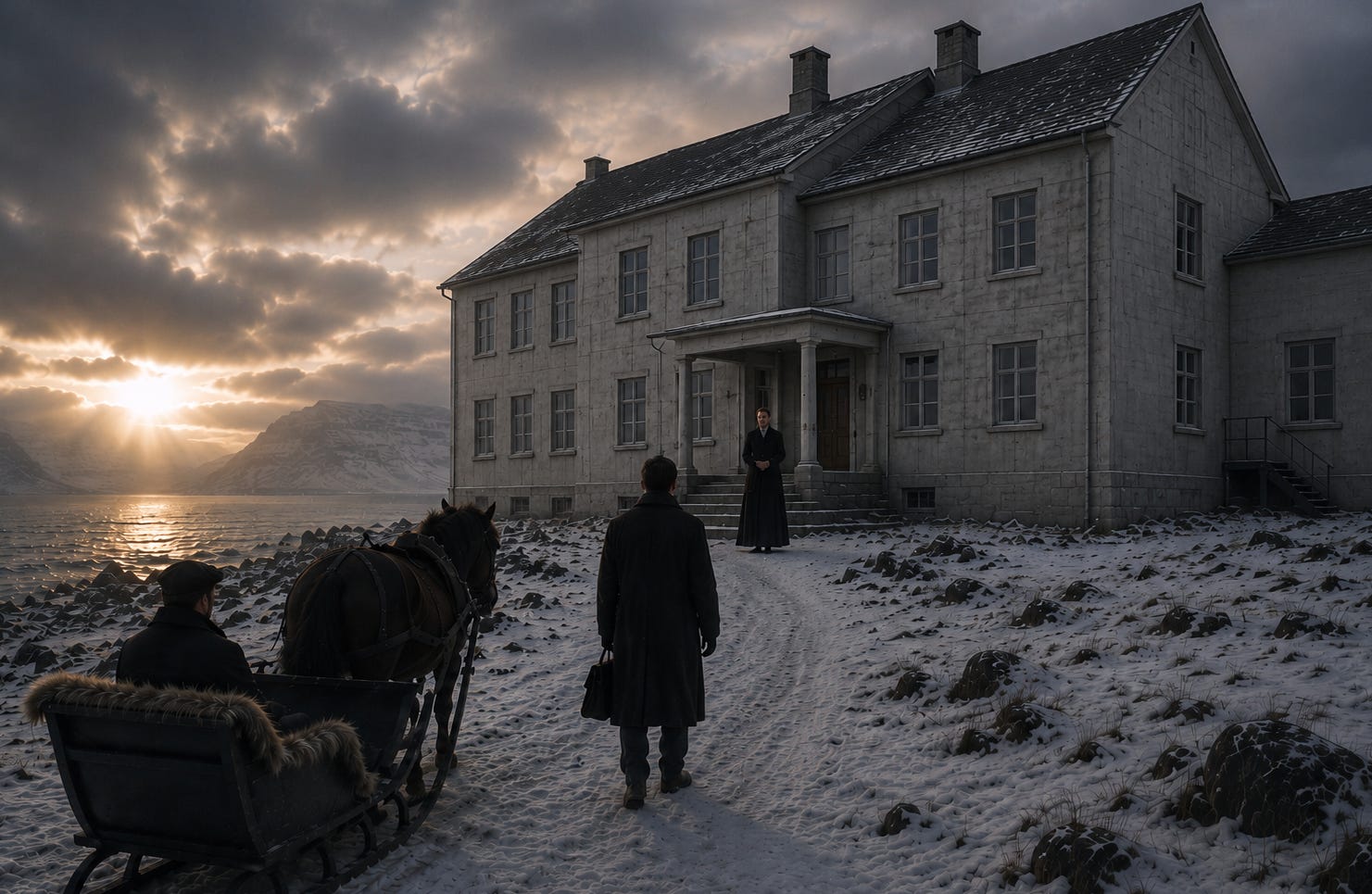
The road ended before they reached the building.
After that, snow.
Mikael sat beside the driver. The horses had their heads down, working into the wind. One slipped, then found its footing again.
He looked back once. Nothing there now but the line they had made in the snow.
“You’ll see it soon,” the driver said.
Mikael nodded. He wasn’t sure what he was meant to see. He had heard about the place. The air. The light. The mountains. The isolation. The order of things. A place of rest. A place of recovery. Words like that.
They rode on without speaking. The bells made a dull sound, sometimes lost in the wind.
He had meant to be certain before leaving.
He wasn’t.
They went on like this. Long enough that the rhythm settled. Then the building appeared. Not suddenly. It had been there, perhaps. Just not visible. A pale structure, gathered out of the weather.
Long and low, with wide windows and balconies facing the water below. It did not look like a hospital. Hospitals belonged somewhere else. Streets. Footsteps. Doors opening and closing.
This place didn’t.
It seemed to belong there.
The driver drew the horses to a stop.
“There,” he said.
Mikael stepped down from the sleigh and stood there, not moving at first, looking at the building. Behind him, the driver had already begun turning the horses.
“You won’t stay?” Mikael asked.
The man shook his head.
“No.”
That was all.
The sleigh turned and moved back along the track they had come. Mikael watched it go longer than necessary. Not sure why. Then he turned toward the building.
A woman was standing by the entrance.
She wore a dark coat and no hat, though the wind crossed the yard freely. Her hair was pinned tightly. The wind moved past her without effect.
“Dr. Mikael Helgason?” she said.
“Yes.”
“I’m Kristín.”
She held out her hand. Her grip was brief. Dry.
“The superintendent is away until tomorrow,” she said. “I’ll show you where things are.”
Mikael looked past her at the building again.
“How many patients?”
“Thirty-two.”
“And beds?”
“Thirty-two.”
She paused.
“We have become popular lately.”
—
He noted the smell inside. He had expected something different.
Not ether. Not carbolic. Milk, wool, damp wood, coal smoke. And beneath it, something he couldn’t name.
The corridor was warm after the outside air. Coats hung from hooks along the wall. Boots stood beneath them. Some lined up carefully. Others not.
Melted snow dripped onto the floorboards and spread.
Somewhere inside, a woman coughed. Once. Then again. Then longer. The sound moved through the building. It was hard to tell from where.
Kristín walked ahead of him.
“We rise at seven. Temperature before breakfast. Rest period after. Outdoor rest if the weather permits. Meals at fixed hours.”
“Do they follow it?” Mikael asked.
“Some do.”
—
Kristín walked with him out onto the veranda.
The patients sat facing the fjord in rows along the wall. They were wrapped in blankets. Some had books in their laps. A few were asleep. Others looked out across the water without focusing on anything in particular.
The air was quiet. Not silent.
Kristín lowered her voice.
“They rest here two hours in the morning and two in the afternoon when possible.”
“Even the advanced cases?” Mikael asked.
“Especially them.”
A pale young man lifted his head.
“This must be the new doctor,” he said.
Kristín glanced at him.
“Einar, you were told not to talk.”
“I was told not to tire myself.”
“That is the same instruction in your case.”
Einar smiled at Mikael.
“You see how they run the place.”
“I’m beginning to.”
“Good. Then you can help me escape.”
Kristín reached over and adjusted the blanket across his chest.
“You have no strength to escape.”
“Not today.”
“Not tomorrow either.”
He turned slightly toward the fjord.
“Spring, then.”
Mikael gave a small smile.
Einar looked at him more seriously now.
“Do you think I’m joking?”
“I don’t think I know you well enough to say.”
“That’s a safe answer.”
He opened his mouth to say something else, then bent forward with the cough. One hand pressed against his mouth. It went on for a while.
When it stopped, he sat still a moment before taking a cloth from his pocket and wiping his hand.
Mikael saw the cloth.
Kristín did too.
Neither of them mentioned it.
—
Further along sat a woman alone.
She was not asleep. Her eyes followed them before they reached her.
“Sigríður,” Kristín said. “Four years here.”
“Four?” Mikael said.
“She came for six months.”
Sigríður smiled faintly but said nothing. Mikael introduced himself.
“I know,” she said.
Her voice was quiet. Not weak.
She looked toward the water again.
A man sat nearby with a newspaper in his lap. The wind kept finding its edge. He held it down, then again.
Mikael glanced at the page. Columns of print. A photograph he could not make out.
The man did not look up. After a while, he lifted the paper and turned a page. It made a dry sound.
Mikael remained there a moment longer than he had meant to.
Then moved on.
—
Mikael’s room was on the second floor. A narrow bed. A desk. A basin. The window overlooked the veranda. The register lay on the table.
He opened it.
The names were written carefully. Age. Admission. Place of origin. Extent of disease.
Some entries were full. Others stopped after only a few lines.
He ran his finger along a margin. Stopped.
Closed the book.
Outside, the patients sat in their chairs, facing the light.
—
By evening, the fjord was fading. From the window, Mikael couldn’t see where the water ended.
He took the letter out of his coat, felt the weight of it in his hand for a second, and laid it flat on the table.
Unopened.
—
Later, he visited the veranda again. The chairs were empty. The blankets folded. Snow had blown in along the boards.
The fjord was no longer visible. Only a pale surface where it had been.
He stood there for a while. Behind him, the building made its quiet sounds. A door closing somewhere below. Water moving through pipes.
Somewhere below him, someone coughed. After a while, another cough answered it.
Then the building settled again.
He turned back inside.
—
At the door, Kristín was there.
“You’ll freeze,” she said.
“I wanted to see it at night.”
“There is nothing to see.”
He looked past her.
“No.”
She watched him. Then opened the door.
“You’ll learn,” she said.
He stepped inside.
—
In his room, he lay down without lighting the lamp. The letter remained on the table. He could make out its shape for a while.
Then not.
Mikael closed his eyes.
If you found this piece useful or enjoyable, you can support my work here.
Next - Chapter 2