
Waiting For Spring - Chapter III

This is Chapter 3 of Waiting for Spring.
Here you can find Chapter 1 and Chapter 2 - in case you missed them.
III
Dear Bjarni,
The book arrived safely. I have read some of it already. I am glad to see you are still writing. Do not spend all your money on tobacco. You remember what drink did to your grandfather. Copenhagen is different from Reykjavík. People disappear more easily there. We have had nice but cold weather here this week. They are still putting us outside most days. There is a new doctor. Make sure you are eating properly. Write when you have time.
Mother.
Sigríður folded the letter but did not put it away.
The book remained open on her lap. She had reached the same poem three times that morning without getting any farther, her eyes moving across the lines while her thoughts wandered elsewhere.
Outside, snow drifted across the veranda.
Copenhagen was a long way south.
—
By morning the weather had changed.
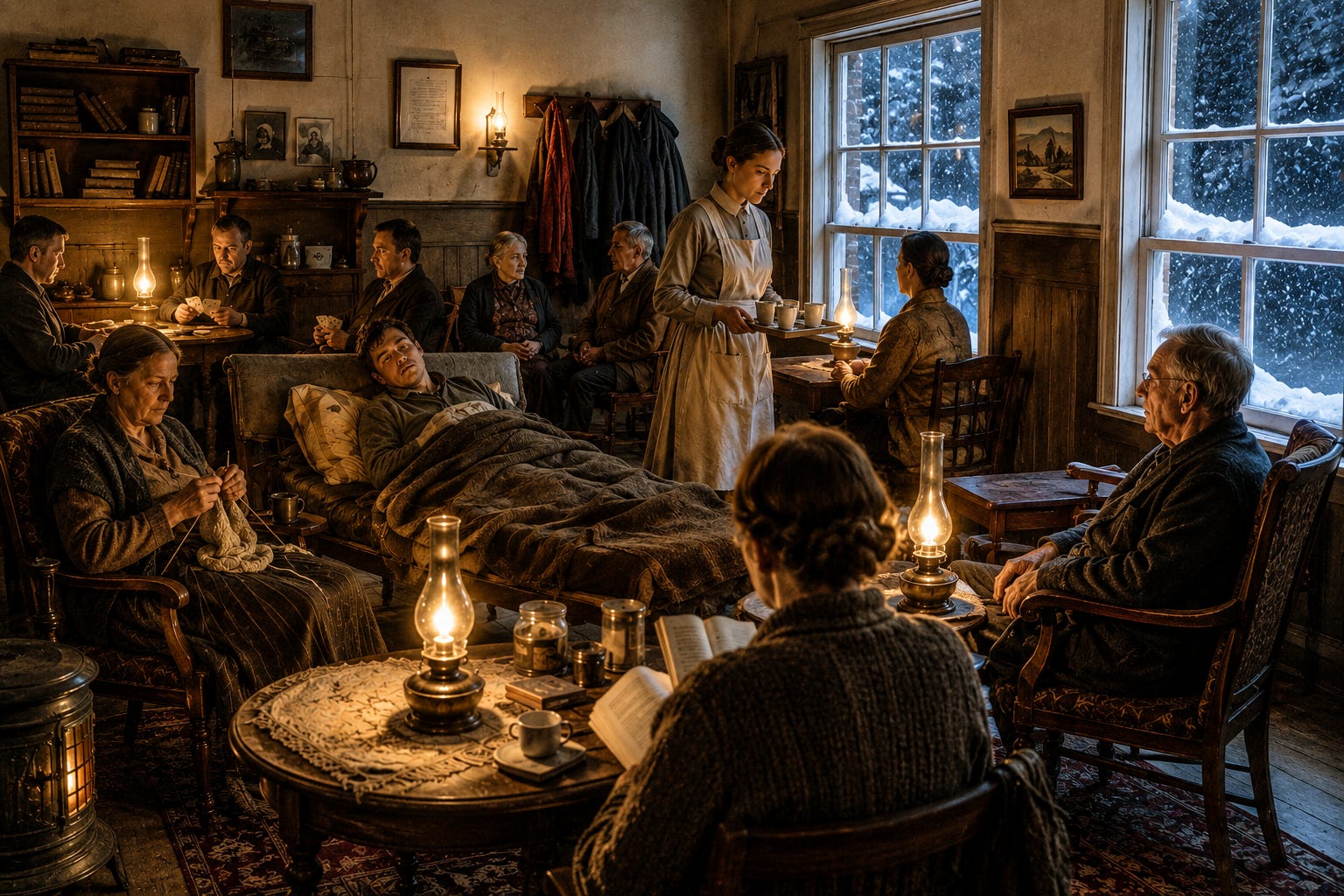
Snow moved low across the ground outside the windows, no longer falling cleanly from above but driving sideways across the valley in long white sheets. The fjord disappeared first, then the road, and by midday, even the nearest buildings appeared only briefly before dissolving back into the storm.
The veranda remained empty after breakfast.
A nurse fastened blankets across the outer doors to keep the drafts down. Lamps were lit in the east corridor before noon. Several patients lingered by the dining-room windows longer than usual.
The road had vanished sometime during the night, and with it went any expectation of visitors, deliveries, or news from the outside world.
The stoker came up from the boiler room shortly before midday, bringing with him the smell of coal dust and damp heat that seemed to belong more to the basement than the rest of the building.
Coal dust stained his hands and the front of his shirt. He stood for a while looking out at the whiteness.
“If this keeps up, we’ll be into next month’s pile before next month arrives.”
Several patients glanced toward the windows and then back to their books.
The stoker nodded once, as though he had expected no reply, and disappeared downstairs again.
A few minutes later, the faint smell of coal smoke drifted through the corridor and mingled with drying wool, coffee, and boiled cabbage from the kitchen.
The building felt warmer than usual. Smaller too.
People settled into chairs with newspapers, books, knitting, or simply their own thoughts. Life continued much as before. Only now the world beyond the windows seemed to have withdrawn entirely.
—
Sigríður sat beside a window with Bjarni’s book open on her lap. Snow had climbed halfway up the glass. Every now and then a gust swept across the pane, briefly clearing it before another drift settled against it. She had been on the same page for several minutes.
Kristín entered carrying folded towels from the laundry room.
“You’ve nearly worn the cover off that book already.”
Sigríður looked up.
“It has only been two days.”
“That’s enough for some books.”
Kristín set the towels on a nearby chair.
“Your son?”
Sigríður nodded.
“He writes more now.”
“Is that a good thing?”
“I suppose it must be.”
Kristín smiled.
“That doesn’t sound very convincing.”
For a moment Sigríður said nothing.
“Copenhagen seems to agree with him.”
“And that worries you.”
It was not a question.
Sigríður looked back at the book.
“The last letter smelled of tobacco.”
“Most student letters do.”
“This one smelled mostly of tobacco.”
Kristín pulled a chair closer and sat down.
“He is young,” she said.
“That’s what people always say.”
“It’s usually true.”
Sigríður turned a page.
“He writes about people I have never met.”
“That seems normal enough.”
“Perhaps.”
The page remained open beneath her hand.
“He used to tell me who he had supper with.”
Kristín smiled.
“And now?”
“Now he writes about poems.”
“He is a poet.”
“He wasn’t born one.”
For a while neither woman spoke.
Outside, the storm continued to erase what little remained of the view.
Finally Kristín stood.
“He may simply be enjoying being twenty.”
Sigríður closed the book.
“That is what worries me.”
Kristín picked up the towels.
“Write to him.”
“I already have.”
“Then let him answer.”
“I suppose.”
“The rest is his business.”
Then she left.
Sigríður watched the doorway for a moment before looking down at the page again. She read the same paragraph twice more without remembering a word of it.
—
Einar had been kept indoors for two days. By now he disliked the weather almost as much as the disease.
The drift outside his window had climbed nearly to the sill. Every hour he found himself checking it, as though something might have changed while he wasn’t looking.
Nothing ever did.
Earlier that morning, he had convinced himself he had heard a wagon on the road. By the time he reached the window, there had been nothing there. Only wind.
“For Christ’s sake,” he muttered.
Afterwards he laughed at himself.
When Mikael entered, Einar was lying on his side facing the wall.
“They’ve imprisoned me.”
“The weather is bad.”
“It was bad yesterday.”
“It wasn’t this bad.”
Einar rolled onto his back.
“Three days.”
He stared at the ceiling.
“Three days. Come back in three months… If anything still means anything by then.”
Mikael pulled the chair closer.
“How is the breathing?”
“How do you think?”
Mikael said nothing.
Einar looked away.
“Sorry.”
Then, after a moment:
“Still happening.”
Mikael opened the chart.
Einar watched him.
“You all do that.”
“What?”
“Look at the paper when you don’t want to look at me.”
Mikael closed it.
“I was reading.”
“I know.”
The window rattled briefly. Both men glanced toward it. Then Einar said quietly:
“Are you discussing me?”
“No.”
“Don’t do that.”
“Do what?”
“Answer like they do.”
Silence settled between them.
Mikael waited. After a while Einar said:
“If the surgeon doesn’t come this week, he’ll never come.”
“That’s not true.”
“You don’t know that.”
“No.”
Einar smiled faintly.
“There. That’s a better answer.”
—
Mikael found Kristín in the lower corridor carrying folded sheets from the laundry room.
“When does the surgeon return?” he asked.
“That depends.”
“On what?”
“Whether the roads decide to reopen.”
She kept walking.
Mikael followed.
“I reviewed Einar’s file.”
“That sounds dangerous.”
“I think the surgeon should examine him.”
“He has.”
“Not recently.”
Kristín stopped.
For a moment she studied him.
“You’re thinking about collapse.”
“Yes.”
“He isn’t strong enough.”
“He’s twenty-eight.”
“That isn’t the same thing.”
“The disease is mostly one-sided. He still has reserve.”
Kristín shifted the sheets slightly in her arms.
“If you’re serious about it, discuss it with Halldór when he comes back.”
“I thought he was away.”
“He is.”
“For how long?”
“Another two weeks.”
The answer seemed to disappoint him.
Kristín noticed.
“Two weeks is a long time.”
“It usually is.”
“If the surgeon comes before then…”
“If the roads open.”
“If the roads open.”
She nodded.
“There is no harm in asking him to look at Einar.”
Mikael waited.
“But?”
“There were two last winter.”
He said nothing.
“One improved for nearly a month.”
“And the other?”
“He drowned in his own blood two nights later.”
Kristín adjusted the sheets in her arms. Then she continued down the corridor.
—
By late afternoon, the storm had settled over the valley. Patients drifted toward the common room as though drawn there by instinct.
The radiators hissed beneath the windows.
Wet scarves and wool coats hung drying nearby. Wet boots stood in a row beneath one radiator. Someone had left a kettle warming beside the stove.
The smell of coffee lingered in the room. A card game occupied one corner. Near the stove, an elderly woman knitted without ever appearing to look at her hands.
Sigríður sat beneath a lamp with Bjarni’s book open on her lap.
The newspaper man occupied his usual chair by the window. Or rather, he occupied the chair where his newspaper ought to have been.
“Has anyone seen it?” he asked.
A card player studied his hand. The woman by the stove continued knitting. Nobody seemed eager to help.
“My newspaper.”
“It’s eight days old,” said Sigríður.
“That wasn’t my question.”
A woman lowered her knitting.
“I think Guðmundur took it.”
“I didn’t.”
“You always do.”
“Not this time.”
The newspaper man looked slowly around the room.
“Somebody has it.”
“Then it’ll turn up,” said Guðmundur.
“That’s what people say about everything.”
A few people smiled. The newspaper never appeared.
Every ten minutes or so the newspaper man seemed to remember its disappearance and became annoyed all over again. Eventually, he gave up searching and folded his hands across his stomach.
For several minutes, nobody spoke.
Then, as though picking up a conversation only he had been having, he said:
“The Germans burned more synagogues than they first reported.”
That drew more attention than the missing newspaper.
Even Einar opened one eye.
“How many?”
“Too many.”
“That’s not a number.”
“No.”
The newspaper man looked toward the darkening windows.
“Vienna first.”
He frowned, as if it didn’t belong to him anymore.
“Or it might have been somewhere else. It moves around.”
After a while Einar said:
“You make everything sound cheerful.”
The newspaper man adjusted his glasses.
“You should see the parts I leave out.”
That earned a few quiet laughs.
Even Sigríður smiled briefly.
Kristín entered carrying a tray of medicine cups.
The atmosphere changed almost immediately. Conversations softened. Cards disappeared into pockets. Patients straightened instinctively.
Einar watched her move between the chairs.
“She walks like she expects trouble.”
Mikael glanced up.
“She usually finds it.”
Einar considered that.
“No.”
“What?”
“I think trouble finds her.”
Kristín stopped beside the sofa.
“Medicine.”
“I was hoping for brandy.”
“Then you chose the wrong institution.”
“No. I chose the wrong lungs.”
A few more smiles appeared around the room.
Outside, the storm continued its work. Inside, the room glowed with lamplight and warmth. For a little while, it almost felt possible to forget how completely the world had disappeared.
—
The electricity failed shortly after supper. The lights flickered once. Twice. Then vanished.
A chair scraped somewhere in the darkness. Someone laughed nervously. Then stopped.
The room felt larger without the lights. And quieter.
“Don’t panic,” Kristín said.
Nobody appeared particularly close to panic. Still, the reassurance seemed appreciated.
She was already moving toward the kitchen.
“Candles.”
A drawer opened. Someone found matches. The first flame appeared near the serving counter. Then another. And another.
Small islands of light emerged throughout the room.
Faces returned one at a time. Different somehow. Older. The shadows moved whenever somebody shifted in a chair. A woman near the stove crossed herself. The gesture passed without remark.
The newspaper man sat with his empty hands folded neatly in his lap.
“At last,” he said.
“What?”
“A day when I couldn’t read it anyway.”
A few people laughed.
“Still haven’t found it?” Einar asked.
“No.”
“Maybe Germany took it.”
“Germany appears to have taken quite enough already.”
That earned another laugh. Even Kristín smiled. The room settled again. Candles flickered softly along the tables. The radiators continued their steady hissing.
Someone began telling a story about a fishing boat trapped in ice near Siglufjörður. Halfway through, another patient interrupted to correct a detail. An argument followed. Nobody seemed particularly bothered by it.
For a while, the storm, the illness, and the darkness beyond the windows all retreated a little.
People talked. Listened. Laughed. Waited.
Outside, winter continued.
Inside, the candles burned steadily.
For a brief hour nobody seemed particularly eager for the electricity to return.
—
The corridors grew quieter as the evening wore on. Doors closed. Voices faded.
Kristín carried a stack of folded towels from the laundry room to the second floor. There had been no particular reason to do it tonight. They could just as easily have waited until morning.
On her way back she stopped outside the medicine cupboard. Checked the inventory. Closed it. Then opened it again. A habit she usually mocked in others.
The letter remained in her pocket. She could feel it whenever she moved.
In the treatment room she straightened a tray that did not need straightening. Adjusted a stack of charts. Refilled a water pitcher that was already nearly full.
She paused beside a window. The glass showed nothing back but her own reflection. After a moment she continued downstairs.
The common room stood empty now. A few candles still burned low on the tables. One had collapsed into a pool of wax. She extinguished it. Then another. The room grew darker.
She could feel the folded paper whenever she moved.
Waiting.
At last she entered the small supply room beside the laundry shelves. Closed the door behind her. And stood still.
For a moment she simply listened.
To the pipes.
To the building settling around her.
Then she reached into her pocket and took out the letter.
—
The paper had softened at the folds.
For a moment, she only looked at it. Her hand did not move
Then she unfolded it carefully and held it closer to the candle.
Her eyes moved across the page. Quickly at first. Then more slowly.
Somewhere above her a floorboard creaked.
Kristín read the paragraph again. And then the line beneath it.
I have told her everything.
She stopped. The candle flickered. For several seconds she did not move. Further down the page:
I will come north if you ask me to.
She read both lines again. Then folded the letter. Too quickly. The paper resisted at the creases. She folded it once more and slipped it back into her pocket.
A floorboard moved outside the door.
Her head lifted immediately. She listened. Nothing.
After a moment she blew out the candle. Darkness filled the room. She remained where she was for another few seconds. Then opened the door and stepped back into the corridor.
The storm was still there.
Waiting.
—
If you found this piece useful or enjoyable, you can support my work here.
Waiting for Spring continues next Thursday.