
Waiting For Spring - Chapter IV
The Road Opens

This is Chapter 4 of Waiting for Spring.
Here you can find Chapter 1, Chapter 2, and Chapter 3 - in case you missed them.
Dear Mikael,
Reykjavík has decided to become Christmas whether people are ready for it or not. The shops are crowded. The baker on Laugavegur has once again convinced half the city that his cakes are worth standing in line for. I’m not sure. Your mother asked after you yesterday. She still believes distance is the only thing standing between you and the life she has planned for you. I did not argue. It seemed unfair to spoil her Christmas. The city looks beautiful in the evenings. The harbor lights disappear into the fog, and everyone pretends winter is more romantic than it really is. You needn’t worry about me. I have long since stopped waiting for you to become someone else. The choir at the cathedral has already begun rehearsing. They sound exactly as they did last year, which I suppose is reassuring in its own way.
Agnes
Mikael folded the letter carefully and placed it beside his coffee cup.
The dining room had begun to empty. A few patients lingered over breakfast, reluctant to return to their rooms. Outside the windows, the sky hung low over the fjord, pale and colorless beneath a thin winter sun.
For the first time in more than a week, the road was visible again. The drifts still lay deep along the edges, but a dark ribbon of earth had begun to emerge from beneath the snow.
People noticed. A road meant movement. Movement meant possibility.
The newspaper man stood by the window with his hands behind his back.
“It’ll be open before Christmas.”
Nobody replied.
“The road?” asked Einar.
“The world.”
Einar snorted.
“That seems ambitious.”
The newspaper man considered this.
“Perhaps.”
Mikael smiled despite himself.
The old man still had not found his newspaper. He claimed somebody had hidden it. Everybody else claimed he had misplaced it. Now that the road was beginning to open, he seemed less interested in finding the old one than in receiving a new one.
The newspaper man looked out toward the valley again.
“Something will arrive.”
“What?”
“I don’t know.”
Einar pushed his cup away.
“Then it’s a very useful prediction.”
A few people laughed.
The old man nodded.
“It usually is.”
The conversation drifted elsewhere.
Around the room, small signs of Christmas had begun to appear. An evergreen branch hung above one doorway. Someone had placed a paper star in the window overlooking the fjord.
Near the stove, two women argued gently about whether Christmas decorations should be put up before the twenty-third.
Mikael rose from the table and slipped Agnes’s letter into his pocket. Outside, a nurse was fastening another paper star to the wall. From somewhere deeper in the building came the faint sound of a piano. A few uncertain notes. Then silence. Then another attempt.
The news traveled through the building before breakfast had fully ended. Halldór was back. Nobody announced it.
The information moved the way most information moved through the sanatorium: through half-heard conversations, opened doors, trays carried from one room to another, and nurses who claimed never to gossip.
By mid-morning, everyone seemed to know.
Mikael saw him first in the corridor outside his office.
Halldór was speaking with one of the orderlies, his back turned toward the window. For a moment, nothing appeared different. Then he turned. The illness had left its mark. Not dramatically. A little less color in the face. A little more grey at the temples. Perhaps a few pounds lighter.
Mikael might not have noticed had he not been looking for signs of it.
Halldór caught his eye and smiled.
“Still here?”
“I thought about leaving.”
“You should never say that in front of patients.”
Mikael laughed. For a moment, they stood together watching snow slide from the roof outside the window. The weather had softened overnight. Water dripped steadily from the eaves. A sound they had not heard in days.
“How are you feeling?” Mikael asked.
Halldór looked toward him.
“Old enough to resent the question.”
“I’ll take that as an improvement.”
“It would be wise.”
The older physician’s smile lingered for a moment before fading. His gaze moved down the corridor.
“Anything I should know about?”
There were dozens of possible answers. A shortage of coal. The storm.The missing newspaper. Blood.
Instead, Mikael found himself saying:
“Einar.”
Halldór looked back at him.
“What about him?”
“I’ve been reviewing his films.”
The smile disappeared.
“Have you.”
Mikael nodded.
“I think he may be a candidate.”
Neither man spoke for a moment. Halldór folded his hands behind his back.
“Let’s take a look.”
Together, they continued toward the X-ray room.
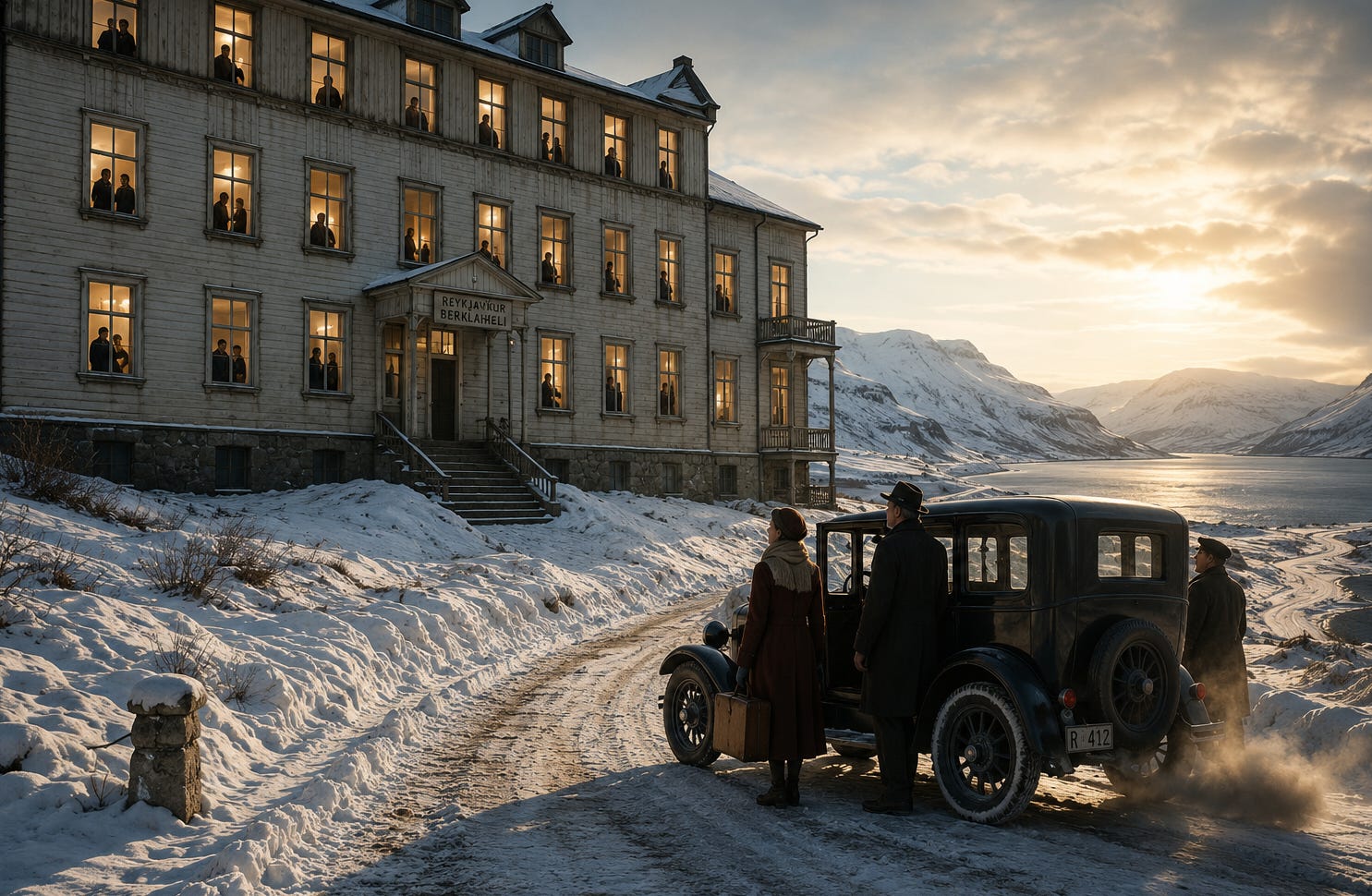
The first sign that the road was truly open came shortly after noon. It arrived in the form of a motorcar. Its appearance caused more interest than anyone cared to admit.
Several patients happened to be standing near windows when it came into view. Others found reasons to pass through the corridor overlooking the road.
Outside, the motorcar climbed the final stretch of road slowly, tires crunching through packed snow. A plume of exhaust drifted briefly across the white hillside before the engine fell silent. By the time it stopped outside the entrance, half the building seemed aware of it.
“A visitor?” asked the newspaper man.
“A patient,” said Sigríður.
“How do you know?”
“Visitors look happier.”
The old man considered this.
“Fair point.”
A driver emerged first. Then a middle-aged man in a dark coat. Finally, a young woman. The young woman stood for a moment beside the vehicle, looking up at the building. Not long. Only a few seconds.
The winter sun sat low behind the mountains. The windows of the sanatorium reflected pale gold against the snow.
“Teacher,” said the newspaper man.
Nobody asked why.
“How can you tell?” Einar said.
“She looks disappointed.”
“That describes most teachers.”
The old man ignored him. The young woman adjusted her scarf and picked up a small suitcase. The older man reached for it immediately. She refused. That seemed to interest Einar.
“Stubborn.”
“Or polite.”
“Same thing.
The entrance door opened. A gust of cold air swept briefly into the building as one of the nurses stepped outside. A few words were exchanged. The driver began unloading luggage. Not much luggage. People rarely arrived with much.
The older man and the young woman stood together for a moment. Then they disappeared inside. The common room grew quieter. The arrival was over. The speculation was not.
“How old?” asked someone.
“Twenty-five.”
“Thirty.”
“Twenty-two.”
“Schoolteacher,” repeated the newspaper man.
“You’re very invested in this.”
“I enjoy being right.”
Einar shifted in his chair.
“You also enjoy being wrong.”
“That too.”
A few minutes later, the door opened. The young woman entered the common room behind one of the nurses. Conversation softened immediately. Everybody remembered their own first day.
The nurse introduced her.
“Anna Jónsdóttir.”
The room responded with a scattered collection of nods and greetings. Anna smiled politely. The smile did not quite reach her eyes. Her gaze moved around the room. The chairs. The windows. The patients. The stove. The piano in the corner. A row of drying mittens beside a radiator.
Everything she would now have to learn.
For a brief moment, her eyes met Mikael’s. Then moved on.
Einar watched her find a chair near the window. Nobody sat beside her. Not because they wished to avoid her. Because newcomers needed a little space.
After several minutes, Einar dragged an empty chair across the floor with his foot. The scrape echoed through the room. He nodded toward it.
“If you’re planning to stay,” he said, “you might as well sit somewhere comfortable.”
A smile traveled slowly around the room. Anna looked surprised. Then smiled. This time, the smile reached her eyes.
The films were waiting for them. Halldór clipped the first one onto the viewing screen and switched on the light. Outside the narrow window, the afternoon was already beginning to fade.
For several moments, neither man spoke. The films themselves seemed to demand silence.
Finally, Halldór pointed.
“Here.”
Mikael stepped closer. The older physician traced a finger along the upper portion of the left lung.
“The cavity is larger.”
Mikael nodded.
“I thought so.”
“You were right.”
The words carried more weight than they should have.
Halldór studied the image a little longer.
“The right side remains relatively spared.”
Another silence followed. Not uncomfortable. Professional. The kind that develops when two people look at the same thing and see it clearly.
Mikael hesitated.
“Do you think he’s a candidate?”
Halldór kept his eyes on the film.
“Perhaps.”
The older physician removed the film and replaced it with another.
“We’ll need the surgeon’s opinion.”
Mikael felt something shift.
Not certainty. Possibility.
Halldór glanced toward him.
“Don’t tell him yet.”
“Why?”
“Because patients hear what they need to hear.”
He studied the second film.
“And disappointment weighs more than disease.”
For a while, neither man spoke.
Then, from somewhere deeper in the building, came the uncertain sound of a piano. The same hymn. The same hesitant mistakes.
Halldór listened.
“He hasn’t improved.”
Mikael looked up.
“The pianist?”
“The pianist.”
For the first time that afternoon, both men laughed.
When Kristín returned to the nurses’ station, the letter was waiting beside the telephone.
She noticed the handwriting immediately. The recognition came before the thought. A small tightening somewhere beneath the ribs. The same hand.
For a moment, she simply stood looking at it. Then she picked it up and slipped it beneath the stack of patient charts she was carrying.
The afternoon continued. Which was precisely what Kristín wanted. Work had always been cooperative in that regard. Work rarely asked difficult questions.
The letter moved with her from room to room. From the station to the treatment room. From the treatment room to the linen cupboard. Unopened.
Near dusk, she found herself standing beside a window overlooking the yard.
The motorcar was gone. Only its tracks remained. Two dark lines cut through the snow toward the road. Already the wind was beginning to soften their edges.
Kristín adjusted the pile of charts in her arms. The letter remained hidden among them. A door opened behind her.
“Still avoiding it?”
Kristín turned. Sigríður stood in the corridor carrying a basket of folded laundry.
“I don’t know what you’re talking about.”
“Of course you don’t.”
Sigríður nodded toward the charts.
“The letter seems to be traveling a great deal for something you haven’t read.”
Kristín looked down. The corner of the envelope was visible between two patient files.
“I’m busy.”
“You’re always busy.”
Kristín laughed despite herself. Sigríður shifted the basket to her other arm.
“Open it.”
“Later.”
For a moment, neither spoke. Outside, the last light of day rested briefly on the snow. Then faded. Sigríður nodded toward the envelope once more.
“You know it won’t improve while waiting.”
“No.”
“Neither will you.”
This time Kristín did not answer.
Sigríður smiled. Not unkindly. Then continued down the corridor.
The letter remained where it was. But it felt heavier now.
That evening, the common room smelled faintly of evergreen. Nobody seemed entirely certain where the branches had come from. By supper, they had been fastened above doorways, draped across shelves, and arranged along the piano.
The effect was modest. Which somehow made it more convincing.
The piano itself remained unconvinced. Its attempts at Christmas music continued throughout the evening with varying degrees of success.
The same hymn appeared several times. Each version sounded slightly different. None sounded entirely intentional.
Across the room, the newspaper man was finally reading a new newspaper. He had hardly spoken since breakfast.
Every now and then, he turned a page and muttered something to himself. At last, he lowered the paper.
“Europe is behaving exactly as I feared.”
“What happened?” asked Einar.
The old man scanned the page again.
“Nothing.”
“Then why are you worried?”
“Because everybody seems to think that’s good news.”
Anna sat near the window. Not quite alone anymore. Not yet fully part of the room. People had begun speaking to her. A few words at a time. Names. Questions. Small pieces of themselves. The slow work of becoming familiar. For the first time since arriving, she found herself listening rather than worrying.
Outside, darkness settled early across the valley. The road remained visible. Only just. A narrow line between the snowbanks. Several patients noticed it whenever they passed the windows. Nobody commented.
Near the piano, the musician finally reached the end of a hymn without a mistake. The room applauded. The pianist bowed.
Einar looked disappointed.
“You were improving.”
The pianist glared at him. A ripple of amusement passed through the room. Even Anna laughed.
Across the room, Mikael watched her for a moment. The fear had not disappeared. But it had loosened its grip. Sometimes that was enough for a first day.
Christmas Eve arrived quietly. No announcement marked it. No bells. No ceremony. People simply woke knowing what day it was.
The kitchen produced better coffee. Someone found oranges. The dining room tables were set with white cloths that appeared only a few times each year. Even the nurses seemed slightly less hurried.
Outside, the valley lay beneath fresh snow. The sky remained clear. By afternoon, a pale winter sun appeared briefly above the mountains before disappearing again.
The common room filled early. Candles stood on the windowsills.
The piano had been persuaded into service once more. Its cooperation remained incomplete. Nobody seemed to mind.
The first hymn began shortly after supper. A few voices joined. Then more. Not particularly well. That wasn’t the point.
The newspaper man sang every verse while pretending not to. Einar sang loudly and incorrectly. The pianist objected. Einar objected to the objection.
Anna did not know the words. She held the paper someone had pressed into her hands and followed the lines without sound.
She looked up. Mikael was standing near the back of the room. Not singing. Not quite smiling. It was as though the room were happening slightly further away from him than from everyone else.
He did not appear to notice her looking.
She looked back down at the paper. The second hymn began. This time, she moved her lips. For a little while, the illness retreated.
Agnes’s letter remained folded in Mikael’s jacket pocket. He had read it three times. The words had not changed. Somehow that seemed unfair. For most of the evening, he had succeeded in avoiding one particular sentence. Now it returned.
I have long since stopped waiting for you to become someone else.
The sentence remained exactly where he had left it. Patient. Unwilling to be ignored.
Mikael had spent years pretending certain conversations were unnecessary. Agnes had always been kinder than honesty required. Perhaps that was what troubled him most. Not the sentence itself. The fact that she had written it without accusation. Without anger. Almost gently.
He found himself wishing she had been angry.
The hymn continued.
Mikael looked toward the piano. People were singing more confidently than before. For a moment, he imagined Agnes sitting alone at her parents’ table in Reykjavík.
Then he looked away.
Across the room, Sigríður sat quietly beside the window. A letter rested in her lap. Bjarni’s latest. She did not open it. She already knew every line. Still, every now and then her fingers touched the folded paper. As though confirming it remained there.
At one point, the music stopped, and somebody asked what Christmas was like in Anna’s village. The answer became a story. The story became three stories. Soon, half the room was arguing about whose Christmas traditions were correct. The debate showed no sign of resolution. That seemed to improve everyone’s mood.
The pianist surrendered his place at the keyboard long enough to refill his coffee.
“Can anyone else play?” asked the newspaper man.
Several people immediately found reasons not to answer. The pianist looked around the room. His gaze settled on Anna.
“You play?”
“A little.”
The room laughed. Nobody believed her. Anna hesitated. Then crossed the room and sat down at the piano. For a moment, she studied the keys.
Then began. The melody was simple. Familiar.
The sort of tune most people knew well enough to sing and not well enough to perform. But the notes arrived where they were supposed to. This already placed her ahead of the previous pianist.
The room gradually grew quieter. Several people began singing. Others simply listened.
The final note faded.
The newspaper man nodded.
“Teacher.”
Anna smiled.
“What?”
“I told them.”
The room laughed again. This time, she laughed with them.
Near the doorway, Kristín moved between tables carrying cups and plates. The unopened letter remained in the pocket of her uniform. Occasionally, her hand brushed against it.
For a while, the room belonged to memory. Fishing boats. Farmhouses. Childhood winters. Parents now dead. Brothers living abroad. Christmases remembered more clearly than the years that followed them. The stories drifted through the room like smoke. Some happy. Some not. Most somewhere in between.
Outside, darkness settled over the valley. The candles burned lower.
One by one, the hymns gave way to conversation. Then silence. Then conversation again. The evening seemed reluctant to end.
Tomorrow would look very much like today. The disease would still be there. The snow would still be there. Everything else would look much the same. But for a few hours, they had managed to forget. Or almost forget.
Near ten o’clock, the room began to empty. Patients drifted toward their rooms.
The pianist closed the keyboard cover. The newspaper man finally admitted he was tired. One by one, the candles were extinguished. Only a few remained. Einar sat watching the last of them. For once, he seemed to have run out of jokes. The room had grown almost quiet when he spoke.
“Maybe next Christmas.”
Nobody answered. Not because they disagreed. Because nobody knew. Einar looked toward the window. Toward the dark valley beyond the glass. Then he nodded once, as though accepting the silence.
Later, after the singing had ended and most of the room had turned back to conversation, Anna slipped quietly into the corridor.
Nobody appeared to notice. Except Sigríður.
The older woman found her a few minutes later standing beside a window overlooking the valley. The mountains were visible in the moonlight.
Anna wiped at her face quickly.
Too late.
Sigríður pretended not to notice.
For a moment, they stood side by side looking out into the darkness.
“My mother will be setting the table now,” Anna said.
The words seemed to surprise her. As though she had not intended to speak them aloud. Sigríður nodded.
“Mine used to sing while she cooked.”
Anna laughed once.
A small sound.
Neither woman spoke for a while.
“You’ll get through tonight,” Sigríður said. “The coffee is better in the morning.”
Much later, after the last patient had gone upstairs and the common room stood empty, Kristín returned to extinguish the remaining candles.
The room felt larger now. The evergreen branches cast long shadows across the walls. A few forgotten cups remained on the tables. The piano sat silent in the corner.
She moved slowly through the room. Collecting plates. Straightening chairs.Creating work where none remained. Outside the windows, the snow reflected the moonlight.
The road was still visible. Barely.
When the room could no longer justify her presence, she switched off the last lamp and stepped into the corridor.
The building had settled into its night sounds. Pipes. Floorboards. The distant closing of a door. Nothing urgent. Nothing requiring her attention.
Which left only the letter.
She stopped outside the nurses’ station. The envelope lay where she had left it. Waiting. Patiently. As though it had known all along that it would eventually win.
“You still haven’t opened it.”
Kristín turned.
Sigríður stood in the corridor carrying a folded blanket.
“I’ve been busy.”
“You’ve been avoiding it.”
“That’s not the same thing.”
Sigríður considered this.
“It looks very similar from here.”
Kristín laughed despite herself.
The sound seemed unusually loud in the quiet building. Sigríður nodded toward the envelope.
“Open it.”
“Now?”
“That would be the traditional order.”
Neither woman moved.
Outside, the wind brushed softly against the building.
Kristín picked up the envelope. She looked at the handwriting. The same careful slant. The same hand.
She opened it. The paper crackled softly.
Sigríður waited.
Kristín read the first paragraph. Then the second. Then returned to the first. The room seemed very quiet.
“What is it?” Sigríður asked.
Kristín lowered the page. She appeared uncertain whether to laugh or cry. Neither arrived.
“The divorce is final.”
The words remained between them. Simple. Irreversible.
Outside the moonlight rested on the snow-covered valley.
Sigríður lowered herself into a chair.
“I suppose that means he’s finally run out of excuses.”
Kristín smiled. There was no happiness in it. Only recognition.
“Yes.”
“And?”
Kristín looked down at the letter. The question had been waiting much longer than the answer. Now it sat in front of her in black ink. Patient. Unavoidable.
“I don’t know.”
Sigríður nodded.
“That’s unfortunate.”
Kristín looked up.
“I was hoping you would.”
For the first time that evening, both women laughed. The sound drifted briefly through the empty corridor before fading. Then neither spoke.
There was nothing more to say.
Outside, beyond the windows, the road stretched south through the snow.
Open once more.
For now.
If you found this piece useful or enjoyable, you can support my work here.
Waiting for Spring continues next Thursday.
Loving this series and the weekly drops!!